Thursday, April 23, 2015

Greece: Troika seeks submission / subservience

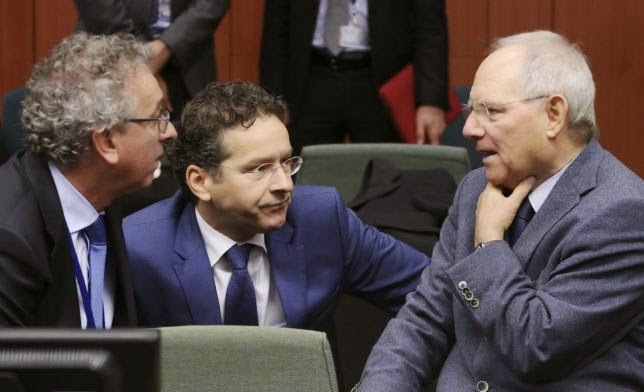
Jeroen Dijsselbloem listens to German Finance Minister Wolfgang Schaeuble
In a more recent article than the one I referred to under point 10 of my previous post "Debt relief for Greece - Austerity kills!", it is said that "a string of academic reports documenting in detail the impacts of austerity on health care and health outcomes in Greece have recently been released [1]," showing how European authorities, IMF and Greek government policies have led to "deaths and attacks on the health of ordinary people" in Greece.

This more recent article, "In Greece, Austerity Kills", was written before Greece got a new government and it is not surprising that it quoted Yanis Varoufakis, the current minister of finance, as a "well-known Greek economist" who was critical of the Troika and the then Greek government.

The article observed that austerity doesn't work, as Europe's ongoing economic stagnation made clear. "Moreover," it said, "whatever government savings result from expenditure reductions, it is important to point out that they are built on 'blood money,' as argued recently by Yanis Varoufakis."

Varoufakis was also quoted as saying that the Greek government was even tougher, or more ruthless, than the Troika. "Varoufakis wrote recently that 'the government is not interested in the slightest in playing tough with the troika,' but 'only with its own people, trying to impress the troika with its ruthlessness."

Varoufakis was again quoted (see the link in the next sentence) when it came to showing how social life in Greece had gone down because of Troika imposed austerity. "The general deterioration of social life due to austerity is clear when the following statistics are considered."

The same Varoufakis is now trying to be tough with the Troika. But he is having hard times, much to the shame of his colleagues in other European countries such as Wolfgang Schaüble and Jeroen Dijsselbloem. 

Before yesterday, Jeroen Dijsselbloem, who heads the group of eurozone finance ministers, said that Greece must meet its obligations and agreements if it wants to remain in the eurozone, according to a Reuters article. "It [Greece] must meet certain conditions and agreements," Dijsselbloem said.

It's the same old story: the new Greek government must behave as its predecessors -- as if elections had never taken place! 

In the meantime, the Tsipras government is losing popularity among its Greek citizens... Is that what the Troika wants?

Yes, I'm afraid that is what it wants. It wants Greece to obey to its rules. It wants to weaken the domestic strength and appeal of Syriza. And, consciously or unconsciously, it wants to give a warning signal to Podemos and its voters in Spain to not follow the Greek example.

It is a shame what Jeroen Dijsselbloem and his colleagues are doing to Greece and to democracy -- even though they might feel proud of cutting a deal with the Greek government, which Dijsselbloem expects to happen "in the coming weeks."

Wednesday, April 22, 2015

Wolfgang Streeck: capitalism will kill itself

Painting by Aafke Steenhuis

Wolfgang Streeck
On Friday, April 3, I wondered in my post "Is capitalism killing democracy?" whether capitalism was killing it and in my next post,"Is the ECB killing democracy?", I wrote that many years ago I had come to the conclusion that it indeed did kill democracy. In that same post I referred to Wolfgang Streeck, emeritus director of the Max Planck Institute for the Study of Societies, who had written the interesting article, "The Crises of Democratic Capitalism".

In a more recent article, How Will Capitalism End?, Wolfgang Streeck observes that "capitalism and democracy had long been considered adversaries" and that "only in the Cold War world did capitalism and democracy seem to become aligned with one another".

After an elaborate analysis of how capitalism succeeeded in conquering various crises over the last four decades, Streeck concludes that "the image [he has] of the end of capitalism—an end that I believe is already under way—is one of a social system in chronic disrepair".

The following conclusion of Wolfgang Streeck is pessimistic (or optimistic, if you wish):

"It seems, however, that disorganized capitalism is disorganizing not only itself but its opposition as well, depriving it of the capacity either to defeat capitalism or to rescue it. For capitalism to end, then, it must provide for its own destruction—which, I would argue, is exactly what we are witnessing today."

Let me give you one more, interesting quote from Streecks article How Will Capitalism End?:

"Contemporary capitalism increasingly suffers from global anarchy, as the United States is no longer able to serve in its postwar role, and a multipolar world order is nowhere on the horizon. While there are (still?) no great-power clashes, the dollar’s function as international reserve currency is contested—and cannot be otherwise, given the declining performance of the American economy, its rising levels of public and private debt, and the recent experience of several highly destructive financial crises. The search for an international alternative, perhaps in the form of a currency basket, is getting nowhere since the US cannot afford to give up the privilege of indebting itself in its own currency. Moreover, stabilizing measures taken by international organizations at Washington’s behest have increasingly tended to have destabilizing effects on the periphery of the system, as in the case of the inflationary bubbles caused in countries like Brazil and Turkey by ‘quantitative easing’ in the centre."

to be continued  

Monday, April 20, 2015

Debt relief for Greece - Austerity kills!

Painted in Greece by Aafke Steenhuis
Last night my wife and I had dinner at the home of our friends Jesse Bos and Jan Smit (here is another interesting, more personal site of Jan Smit), talking about life and politics including the case of Greece. This morning I sent my friends the following message: 

"Dear friends, our conversation last night turned around in my head this morning and, still in bed, I thought the following: 
1. The solution of the Greek debt problem is as old as the night (older than Methuselah): debt relief and debt cancellation. 
2. The (social) democratic government of the Unidad Popular in Chile in 1970-1973, SYRIZA in Greece in 2015- ? , and the possible government of Podemos in Spain in ? face the same problem: resistance and subversion by the capitalist "order" and capitalist institutions. 
3. There is a global political-economic, social, cultural, psychological and ecological system that requires:
    
(A) continuous partial and full analysis of problems and challenges
    
(B) "marginal" troubleshooting
    
(C) "fundamental" reforms.

4. To speak about Greece as if the only problem is its external debt (commercial, bilateral and multilateral) is too limited.
5. But if you limit yourself to discussing only the Greek debt problem, you must speak in serious terms about a good way to solve that problem. 
6. The correct approach would have been in 2010 to avoid that the Greek debt problem would worsen with "rescue" loans by the EU and the IMF (see what Brazilian ED at the IMF, Paulo Nogueira Batista, said with respect to that, "Remarkable interview on Greek debt with IMF Executive Director Paulo Nogueira Batista". 
7. A good approach now, with the new government of SYRIZA, would be that creditors and Greece agree on relief and cancellation of Greek debt.
8. In the last centuries sensible debt relief and debt cancellation (reduction) measures have been applied, including perpetual bonds, ie, conversion of debt into bonds that are not repaid such as the 19th century "consols" - see pages 393-95 of my article Jan Joost Teunissen, "The International Monetary Crunch: Crisis or Scandal?", Alternatives, July 1987, under the caption "It is not the widows who will cry".
 9. We must also look at the new proposals to alleviate and reduce debt, already many years ago put on the table such as, for example, a mechanism for restructuring sovereign debt (SDRM), that we have frequently discussed with financial authorities in FONDAD conferences - see the links below to FONDAD books I found by googling "fondad sdrm" .
 
10. The "authorities" are responsible for the unnecessarily dying of people, see for example this article, "Recessions can hurt, but austerity kills". 

The food and your company were marvelous!

  1. Global Crisis Prevention and Liquidity Provision - FONDAD ...

    www.fondad.org/.../Fondad-Diversity-Chapter16.pdf
  2. ... Consensus. FONDAD, The Hague, December 2004, www.fondad.org ... effort were devoted to discussing the SDRM and collective action clauses (CACs), the ...
  3. 33047-Binnenwerk net - FONDAD Forum on Debt and ...

    www.fondad.org/uploaded/.../Fondad-Stability-Ch19.... - Vertaal deze pagina
    FONDAD, September 2003, www.fondad.org. 19. Fostering Financial Stability ... been difficult to find agreement on the SDRM among the IMF member states, the ...
  4. [PDF]7 The Democratic Deficit of International Arrangements

    www.fondad.org/.../Fondad-ProtectingPoor-Chapter7...

  5. door JA Ocampo - ‎Geciteerd door 2 - ‎Verwante artikelen
    the Sovereign Debt Restructuring Mechanism (SDRM), it does not mention the important issue that ... Fondad, The Hague, November 2005. www.fondad.org

Friday, April 17, 2015

Is the ECB killing democracy?

This young lady, German philosophy student Josephine Witt, jumped on the table when Mario Draghi, president of the European Central Bank, gave a press conference at the headquarters of the ECB in Frankfurt on April 15, 2015. It drew a lot of media attention including images showing her action and her beauty. One commentator admired her elegant jump on the table. Another observed that a guard took her at her breast.

It took me a while before I found on internet the text of the leaflet Josephine Witt was throwing around while standing in front of Draghi on the conference table - see text below. As you can hear in this video, Mario Draghi Showered With Shouts, Confetti in Protest or this, ECB President Mario Draghi attacked by protester, she also shouted: "End ECB dictatorship!"

In my previous draft post I raised the question of whether current capitalism is killing democracy. Many years ago I came to the conclusion that it indeed does kill democracy and wrote various pieces arguing this. I just mention two: "The International Monetary Crunch: Crisis or Scandal?", Alternatives, July 1987, and "The economy is too serious a thing to be left to the economists", April 25, 2008.

Recently, my wife returned enthusiastically from a talk given at the then occupied administrative centre of the Amsterdam University by Wolfgang Streeck, emeritus director of the Max Planck Institute for the Study of Societies. If you are interested in Streeck's thoughts, you may want to read this article, "The Crises of Democratic Capitalism" (in either English, Spanish or Portuguese).

I intend to eloborate on my previous post when I have time and appetite.

Here is the text of the leaflet Josephine Witt threw around at ECB's headquarters: 
We own our own lives -
and in the face of the overwhelmingly powerful external
environment of the ECB’s monetary police,
sometimes it’s hard to remember.

We own our own lives -
and they’re not the chips in the ECB’s gambling game,
not to be played with, not to be sold, not to be devastated.

We own our own lives!
-will be the outcry of those who face repression,
when we begin to see our poverty not as personal defeat or unchangeable destiny.

ECB,
master of the universe,
I come to remind you that there is no god,
but there are people, behind those lives,
and if you rule instead of serving,
you will hear our outcries louder, brighter, inside and outside your halls, everywhere, and you shall deserve no rest.

And while the ECB can only persist in its autocratic hegemony, depending on states of surveillance and police,
finally, the daily violence is enrooted here,
we will find our radical answers
and act with no violence against those human disasters.

Because we will not accept the insane narrative that the ECB wants to impose to all people wherein even freedom of speech and dignity can be sold to the bank in order to survive. Persisting in its arrogance against the people, the ECB increases perilously its own debt to them. A press conference is not enough to call it "democracy".
I do not expect this illegitimate institution to hear my voice, neither to understand my message,
it would be too much to ask,
but I know for a fact that a lot of people do understand very well the matter.
Today I'm just a butterfly sending you a sentence, but be afraid more are coming. We will take back the power over our own lives.
The ECB’s debt is not yet paid.

Friday, April 3, 2015

Is capitalism killing democracy?

Rebuiding of former Shelll tower in Amsterdam (painting by Aafke Steenhuis) - "I’ll be a fabulous party host and create things that thrill the senses. I’ll be open day and night, 25 hours a day, 8 days a week."


this is a draft

Is capitalism killing democracy?
If the answer is yes, what kind of capitalism kills it?
Is there a kind of capitalism that does not kill democracy, but rather supports and stimulates it?

Capitalism killed democracy in Chile in 1973.
Capitalism began to undermine democracy in Europe and the US in the 1980s when political parties embraced neoliberal policies.
Democracy in Europe was undermined in addition by adopting the euro in the 1990s.

Syriza and Podemos are coalition forces in Greece and Spain who try to socialise and democratise capitalism.

Capitalism and its political supporters in Europe are now (successfully?) dividing and undermining Syriza by forcing it to accept neoliberal capitalist 'reforms'.

If Syriza fails in Greece, the hope of many European and other citizens will be undermined.

Democracy cannot live without hope.

to be continued

Monday, March 30, 2015

Greece sells Piraeus Port to China?

Hafen von Piräus: Kehrtwende beim Privatisierungsprojekt

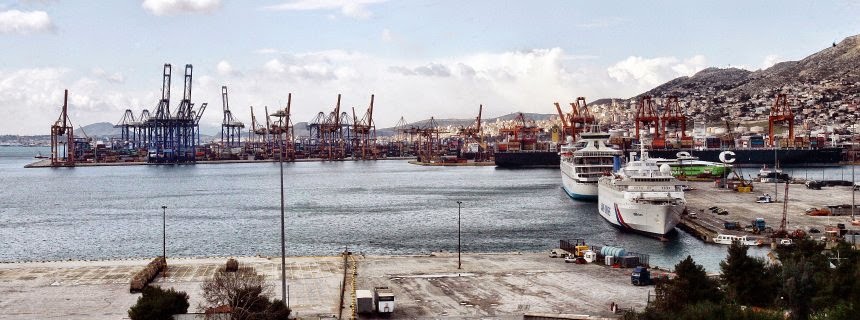
Greece's creditors seem to be successful in pushing the government of Alexis Tsipras to yet go ahead with further privatising its largest port, Piraeus, while two months ago it still had announced it would maintain state control of Piraeus Port. The Greek government is expected to sell its majority stake of 67 percent to the Chinese company Cosco which already owns two container terminals of the partly privatised port. This is what Greek deputy prime minister Yannis Dragasakis told China's official Xinhua news agency on March 28, 2015. (The picture above is from Der Spiegel of 28 March and the caption says: Port of Piraeus: U-turn in privatisation project.)

According to Wall Street Journal of 29 March, Greece expects to raise at least 500 million euros from the sale of Piraeus Port. Greek officials also told creditors they will seek to privatise operating concessions at 14 regional airports, said Wall Street Journal.

Greece's creditors - European countries, ECB and IMF - are putting pressure on the Tsipras government to stick to 'reforms' agreed by the previous Greek governments with the Troika. 

Prime Minister Alexis Tsipras, has insisted his government will not carry out any recessionary measures to cut wages, jobs or pensions. But it seems that Greece's creditors insist Tsipras should stick as well to 'reforms' earlier agreed with respect to labour and pensions.

In reading this and other news about Greece it was ironic that another article I read this morning, about damage caused in Greece by Nazi Germany during the second world war, carried a picture of Piraeus as illustration. Below I copy that picture and the first part of the article, titled "Greece: debt and memory of war", written by Conn Hallinan.

Greece: debt and memory of war

Conn Hallinan
Damage from the German bombing of Piraeus, Greece, on April 6, 1941. Australian War Memorial Image/Wikimedia

March 23 2015

Memory is selective and therein lies an explanation for some of the deep animosity between Berlin and Athens in the current debt crisis that has shaken the European Union (EU) to its foundations.
For German Finance Minister Wolfgang Schauble, "memory" goes back to 2007 when Greece was caught up in the worldwide financial conflagration touched off by American and European speculators. Berlin was a major donor in the 240 billion euro "bailout" - 89 percent of which went to pay off the gambling debts of German, French, Dutch and British banks. Schauble wants that debt repaid.
Millions of Greeks are concerned about unpaid debts as well, although their memories stretch back a little further.
In July 1943 Wehrmacht General Hubert Lanz, commander of the First Mountain Division, was annoyed because two of his officers had been threatened by civilians in the western Greek town of Kommeno. It was dangerous to irritate a German commander during the 1941-45 occupation of Greece.
Lanz first murdered 153 men, women and children - ages one to 75 - in Mousiotitsas, then surrounded Kommeno, where his troops systematically killed 317 people, including 172 women. Thirteen were one year old, and 38 people were burned alive in their houses. After the massacre, the soldiers ate their lunch in the village square, surrounded by the bodies of the dead, and then pushed on to other villages, killing more than 200 civilians.
It was not the first, nor the last massacre of Greeks, and most people in that country can recite them like the beads on a rosary: Kondomari (60 killed); Kardanos (180 killed); Alikianos (118 killed); Viannos (over 500 killed); Amari (164 killed); Kalavryta (over 700 killed); Distomo (214 killed). All in all, the Germans destroyed more than 460 villages, executed 130,000 civilians, and murdered virtually the entire Jewish population - 60,000 - during the occupation.
On top of that, Athens was forced to "lend" Germany 475 million reichsmarks - estimated today at 14 billion euros - to pay for the occupation. Adding interest to the loan makes that figure somewhere around 95 billion euros.
Greece's public debt is currently 315 billion euros.
The Greeks "remember" a few other things about those massacres. Gen. Kurtl Student, the butcher of Kondomari, Kardanos, and Alikianos, was sentenced to five years after the war, but got out early on medical grounds. The beast of Mousiotitsas and Kommeno, Gen. Lanz, was sentenced to 12 years, served three, and became a major military and security advisor to the German Free Democratic Party. In 1954 he wrote a book about his exploits and died in bed in 1982. Gen. Karl von Le Suire of Kalavryta fame was not so lucky. Captured by the Soviets, he died in a Stalingrad POW camp in 1954. Lt. Gen. Friedrich-Wilhelm Muller, who ordered the Viannos massacre, was tried and executed by the Greeks in 1947.
It is not hard to see why many Greeks see a certain relationship between what the Germans did to Greece during the occupation and what is being done to it today. There are no massacres - although suicide rates are through the ceiling - and no mass starvation, but 44 percent of the Greek people are now below the poverty line, the economy is shattered, and Greeks feel they no longer control their country. Up until the last election, they didn't. The Troika - the European Central Bank, the European Commission, and the International Monetary Fund - dictated the price of the loan: layoffs, wage and pension reductions, and huge cutbacks in health care. True, their occupiers did not wear the double thunderbolts of the SS or the field green of the Wehrmacht, but armies in pinstripes and silk ties can inflict a lot of damage.
(...)
Thursday, March 26, 2015

Yanis Varoufakis - Of Greeks and Germans: Re-imagining our shared future


A few days ago Yanis Varoufakis published a post on his blog "thoughts for the post-2008 world" that he later withdrew and published in a revised and extended version with Project Syndicate. Below are the Syndicate version and a copy of his original blog post that I saved in my computer. There is also a German translation of the original blog post published by Markus Wichmann "Yanis Varoufakis: Von Griechen und Deutschen – Unsere gemeinsame Zukunft neu überdenken".

Deescalating Europe’s Politics of Resentment


ATHENS – A German television presenter recently broadcast an edited video of me, before I was Greece’s finance minister, giving his country the middle-finger salute. The fallout has shown the potential impact of an alleged gesture, especially in troubled times. Indeed, the kerfuffle sparked by the broadcast would not have happened before the 2008 financial crisis, which exposed the flaws in Europe’s monetary union and turned proud countries against one another.
When, in early 2010, Greece’s government could no longer service its debts to French, German, and Greek banks, I campaigned against its quest for an enormous new loan from Europe’s taxpayers to pay off those debts. I gave three reasons.

First, the new loans did not represent a bailout for Greece so much as a cynical transfer of private losses from the banks’ books onto the shoulders of Greece’s most vulnerable citizens. How many of Europe’s taxpayers, who have footed the bill for these loans, know that more than 90% of the €240 billion ($260 billion) that Greece borrowed went to financial institutions, not to the Greek state or its people?
Second, it was obvious that if Greece already could not repay its existing loans, the austerity conditions on which the “bailouts” were premised would crush Greek nominal incomes, making the national debt even less sustainable. When Greeks could no longer make payments on their mountainous debts, German and other European taxpayers would have to step in again. (Wealthy Greeks, of course, had already shifted their deposits to financial centers like Frankfurt and London.)
Finally, misleading peoples and parliaments by presenting a bank bailout as an act of “solidarity,” while failing to help ordinary Greeks – indeed, setting them up to place an even heavier burden on Germans – was destined to undermine cohesion within the eurozone. Germans turned against Greeks; Greeks turned against Germans; and, as more countries have faced fiscal hardship, Europe has turned against itself.
The fact is that Greece had no right to borrow from German – or any other European – taxpayers at a time when its public debt was unsustainable. Before Greece took any loans, it should have initiated debt restructuring and undergone a partial default on debt owed to its private-sector creditors. But this “radical” argument was largely ignored at the time.
Similarly, European citizens should have demanded that their governments refuse even to consider transferring private losses to them. But they failed to do so, and the transfer was effected soon after.
The result was the largest taxpayer-backed loan in history, provided on the condition that Greece pursue such strict austerity that its citizens have lost one-quarter of their incomes, making it impossible to repay private or public debts. The ensuing – and ongoing – humanitarian crisis has been tragic.
Five years after the first bailout was issued, Greece remains in crisis. Animosity among Europeans is at an all-time high, with Greeks and Germans, in particular, having descended to the point of moral grandstanding, mutual finger-pointing, and open antagonism.
This toxic blame game benefits only Europe’s enemies. It has to stop. Only then can Greece – with the support of its European partners, who share an interest in its economic recovery – focus on implementing effective reforms and growth-enhancing policies. This is essential to placing Greece, finally, in a position to repay its debts and fulfill its obligations to its citizens.
In practical terms, the February 20 Eurogroup agreement, which provided a four-month extension for loan repayments, offers an important opportunity for progress. As Greece’s leaders urged at an informal meeting in Brussels last week, it should be implemented immediately.
In the longer term, European leaders must work together to redesign the monetary union so that it supports shared prosperity, rather than fueling mutual resentment. This is a daunting task. But, with a strong sense of purpose, a united approach, and perhaps a positive gesture or two, it can be accomplished.
This is an updated and extended version of a post at yanisvaroufakis.eu.


Of Greeks and Germans: Re-imagining our shared future

Any sensible person can see how a certain video[1] has become part of something beyond a gesture. It has sparked off a kerfuffle reflecting the manner in which the 2008 banking crisis began to undermine Europe’s badly designed monetary union, turning proud nations against each other.
When, in early 2010, the Greek state lost its capacity to service its debts to French, German and Greek banks, I campaigned against the Greek government’s quest for an enormous new loan from Europe’s taxpayers. Why?
I opposed the 2010 and 2012 ‘bailout’ loans from German and other European taxpayers because:
  • the new loans represented not a bailout for Greece but a cynical transfer of losses from the books of the private banks to the weak shoulders of the weakest of Greek citizens. (How many of Europe’s taxpayers, who footed these loans, know that more than 90% of the €240 billion borrowed by Greece went to financial institutions, not to the Greek state or its citizens?)
  • it was obvious that, at a time Greece could not repay its existing loans, the austerity conditions for giving Greece the new loans would crush Greek nominal incomes, making our debt even less sustainable
  • the ‘bailout’ burden would, sooner or later, weigh down German and other European taxpayers once the weaker Greeks buckled under their mountainous debts (as moneyed Greeks had already shifted their deposits to Frankfurt, London etc.)
  • misleading peoples and Parliaments by presenting a bank bailout as an act of ‘solidarity to Greece’ would turn Germans against Greeks, Greeks against Germans and, eventually, Europe against itself.
In 2010 Greece owed not one euro to German taxpayers. We had no right to borrow from them, or from other European taxpayers, while our public debt was unsustainable. Period!
That was my ‘controversial’ point in 2010: In 2010, Greece should have borrowed not one euro before entering into debt restructuring procedures and partially defaulting to its private sector creditors.
Well before the May 2010 ‘bailout’, I urged European citizens to tell their governments not to even think of transferring private losses to them.
To no avail, of course. That transfer was effected soon after[2] with the largest taxpayer-backed loan in economic history given to the Greek state on austerity conditions that have caused Greeks to lose a quarter of their income, making it impossible to repay private and public debts, and causing a hideous humanitarian crisis.
That was then, in 2010. What should we do now, in 2015, that Greece remains in crisis and our people, the Greeks and the Germans, have, regrettably but also predictably, descended into a mutual ‘blame game’?
First, we should work towards ending the toxic ‘blame game’ and the moralising finger-pointing which benefit only the enemies of Europe.
Secondly, we need to focus on our joint interest: On how to grow and to reform Greece rapidly, so that the Greek state can best repay debts it should never have taken on while looking after its citizens as a modern European state ought to do.
In practical terms, the 20th February Eurogroup agreement offers an excellent opportunity to move forward. Let us implement it immediately, as our leaders have urged in yesterday’s informal Brussels meeting.
Looking ahead, and beyond current tensions, our joint task is to re-design Europe so that Germans and Greeks, along with all Europeans, can re-imagine our monetary union as a realm of shared prosperity.
—————————–
[1] Whose showing derailed an otherwise constructive discussion on German television.
[2] First in May 2010 (€110 billion) and then again in the Spring of 2012 (another €130 billion).