July 18, 2018
Chinese investors are lining up to take advantage of cheap real
estate in Greece where prices hit bottom during the economic crisis. For
Chinese buying property in Greece is of high interest due to the Golden
Visa program that grants them a 5-year residence permit for them and
their family.
Foreign buyers are lining up to invest in real estate in
Greece, a market that crashed during the country’s economic crisis and
has yet to fully recover. Prices dropped by around 45 percent though
real estate agents say in some areas of Athens the real drop reached
close to 60 percent. Prices hit rock-bottom with some apartments in the
center of Athens selling for as low as 10,000-15,000 euros.
But it’s not only the cheap prices that make Greek real
estate appealing to foreign investors (much cheaper than other European
countries like Portugal, Spain, Italy and Germany).
Greece’s residence-for-investment program, introduced in
2013 and one of the cheapest in Europe, has been luring thousands of
foreign buyers who, when they buy real estate property worth at least
250,000 euros (292,625 US dollars), get a five-year residence permit
that also allows them and their families to freely travel in most of
Europe.
Chinese buyers are the top nationality applying for the
so-called “Golden Visa Program.” According to data from Enterprise
Greece, by the end of 2017 Greece had granted 2,305 “golden visas.”
Chinese investors make up almost half of all investors having been
granted 1,011 visas, followed by those from Russia (395 visas) and
Turkey (222 visas).
The rich have benefited from the last international "crisis" and increase their wealth. What about the poor and the middle classes? Here is an article from the French journal La Tribune about the happy 1% (if you cannot read French, google translation is pretty good):
Nonobstant la forte correction de l'ordre de 10 %
survenue récemment sur les bourses, la première économie mondiale, celle
qui précède toujours toutes les autres en termes de croissance comme de
dépression, celle qui sert d'exemple ultime en matière de néo
libéralisme, - l'économie américaine - s'est donc redressée de manière
spectaculaire depuis la crise des années 2007 - 2008. Marché de
l'immobilier en constante progression, chômage au plus bas depuis une
génération et marchés boursiers euphoriques sont autant de preuves de ce
redressement exemplaire d'une économie ayant néanmoins frôlé la
catastrophe il y a dix ans.
La classe moyenne américaine est pourtant fort loin
d'avoir retrouvé son niveau de vie précédent cette récession, et n'a pas
non plus récupéré toutes ses richesses volatilisées à la faveur de la
crise financière. En fait, tirés vers le bas par des revenus stagnants -
en dépit d'une conjoncture économico-financière florissante - les
salariés US sont aujourd'hui confrontés à une situation et acculés à des
extrémités équivalentes à celles ayant prévalu au milieu des années
1990. C'est donc à un authentique retour vers le passé qu'est contrainte
la classe moyenne américaine - naguère si enviée par les européens -
car une étude de la Réserve Fédérale démontre
une chute de 8% de sa richesse en vingt ans ! Cette rétrogradation se
transforme cependant en une déchéance en bonne et due forme pour les
moins bien nantis dont les maigres avoirs ont littéralement fondu de 22%
durant la même période. Les plus pauvres sont effectivement les damnés
d'un système qui fonctionne par les riches et pour les riches ayant,
eux, augmenté leur fortune de 146% depuis 1998 ! Les disparités des
revenus sont encore plus choquantes car, tandis que 90% des
citoyens américains ont subi un effondrement de 50 % du fruit de leur
travail, les 1% les plus riches d'Amérique ont pu jouir d'une flambée de
23 % de leurs revenus ! À présent que les bourses semblent
décrocher ou, à tout le moins, devoir s'ajuster sur l'économie réelle
que vivent au quotidien les vrais gens, tournons-nous vers les Gates,
les Bezos, les Zuckerberg, les Musk et vers les frères Kock qui ont très
certainement analysé et la Grande Dépression et les liquéfactions des
années 2007 - 2008, car on peut légitimement douter qu'ils en aient tiré
un quelconque enseignement. L'économie de ce début de XXIe siècle n'est
effectivement en rien plus saine que celle de la fin des années 1990
car le capitalisme de 2018 est encore et toujours tiré par la seule
locomotive de la finance. Dans ce jeu de dupes à
somme nulle pour la société civile, des géants comme Apple disposent
d'une richesse aberrante évaluée à environ 375 milliards de dollars qui
ne seront évidemment pas réinvestis sur leurs produits mais sur les
marchés financiers et dans une ingénierie qui leur permettront de se
soustraire autant que possible à l'impôt. Dans ce monde de 2018, les
entités comme Apple et bien d'autres ne sont plus qu'un gigantesque
fonds spéculatif dont seulement un wagon est dédié à l'innovation
technologique, et dont la quasi-totalité des éléments constitutifs ne
bénéficient donc ni à la consommation ni à la société. Après
la tragédie des années 2007 à 2010, et alors que les classes moyennes
sont en plein déclassement au sein de toutes les nations occidentales,
les heureux 1% doivent très sérieusement peser les conséquences de leurs
actions et de leurs décisions, et surtout ne pas se cacher derrière le
prétexte - usé jusqu'à la lie - selon lequel ils ne pouvaient prévoir un
nouveau et inéluctable cataclysme accentué - sinon provoqué - par leur
appât immodéré du gain. Alors que le monde de la finance semble parti
pour de nouvelles secousses d'hyper volatilité et d'hyper instabilité -
qui sont sa marque de fabrique- nul ne peut plus aujourd'hui se
prévaloir d'ignorer les conséquences de ses actes.
International financial crises have plagued the world
in recent decades, including the Latin American debt
crisis of the 1980s, the East Asian crisis of the late
twentieth century, and the global financial crisis of
2007-09. One of the basic problems faced during these
crises is the lack of adequate preventive mechanisms, as
well as insufficient instruments to finance countries in
crisis and to overcome their over-indebtedness.
Resetting the International Monetary (Non)System
provides an analysis of the global monetary system and
the necessary reforms that it should undergo to play an
active role in the twenty-first century and proposes a
comprehensive yet evolutionary reform of the system.
Criticising the ad hoc framework- a "(non)system"-
that has evolved following the breakdown of the Bretton
Woods arrangement in the early 1970's, Resetting the
International Monetary (Non)System places a special
focus on the asymmetries that emerging and developing
countries face, analysing the controversial management
of crises by the International Monetary Fund and
proposing a consistent set of reform proposals to design
a better system of international monetary cooperation.
Policy orientated and structured to deal in a sequential
way with the issues involved, it suggests provision of
international liquidity through a system that mixes the
multicurrency arrangement with a more active use of the
IMF's Special Drawing Rights; stronger mechanisms of
macroeconomic policy cooperation, including greater
cooperation in exchange rate management and freedom to
manage capital flows; additional automatic
balance-of-payments financing facilities and the
complementary use of swap and regional arrangements; a
multilateral sovereign debt workout mechanism; and major
reforms of the system's governance.
Protesters
clash with riot police outside the parliament building during a
demonstration against planned government reforms that will restrict
workers right to strike in Athens, Greece, January 15, 2018.
REUTERS/Costas Baltas
Reuters reported recently about protests in Greece against "reforms" demanded by the Troika of the European Commission, the European Central Bank, and the IMF:
"Greece’s parliament on Monday [January 15] passed a swathe of reforms demanded by international lenders in exchange for fresh bailout funds, a success for the government but a blow to thousands of people protesting outside. The bill introduces a new electronic process for foreclosures on overdue loans and arrears to the state, opens up closed professions, restructures family benefits and makes it harder to call a strike. About 20,000 people rallied outside parliament during the vote. Bus, subway and city rail services were disrupted and some flights were grounded as workers went on strike to protest against the bill."
My sister Barbara, who lives in Greece, commented in a letter to me:
"The consequences will be felt in the course of this year for many people in benefits, by auctions of houses, privatizations, restrictions on the right to strike, etc. The slogan of the government is: "just development ", which refers to making Greece attractive to foreign capital, the sale of ports, airports, railways, electricity, water, etc. while the population is kept alive by occasionally giving them some extra money in the form of a one-off benefit, alms, as it is called, but on the other hand to limit wages and benefits. And the brain drain still goes on ...."
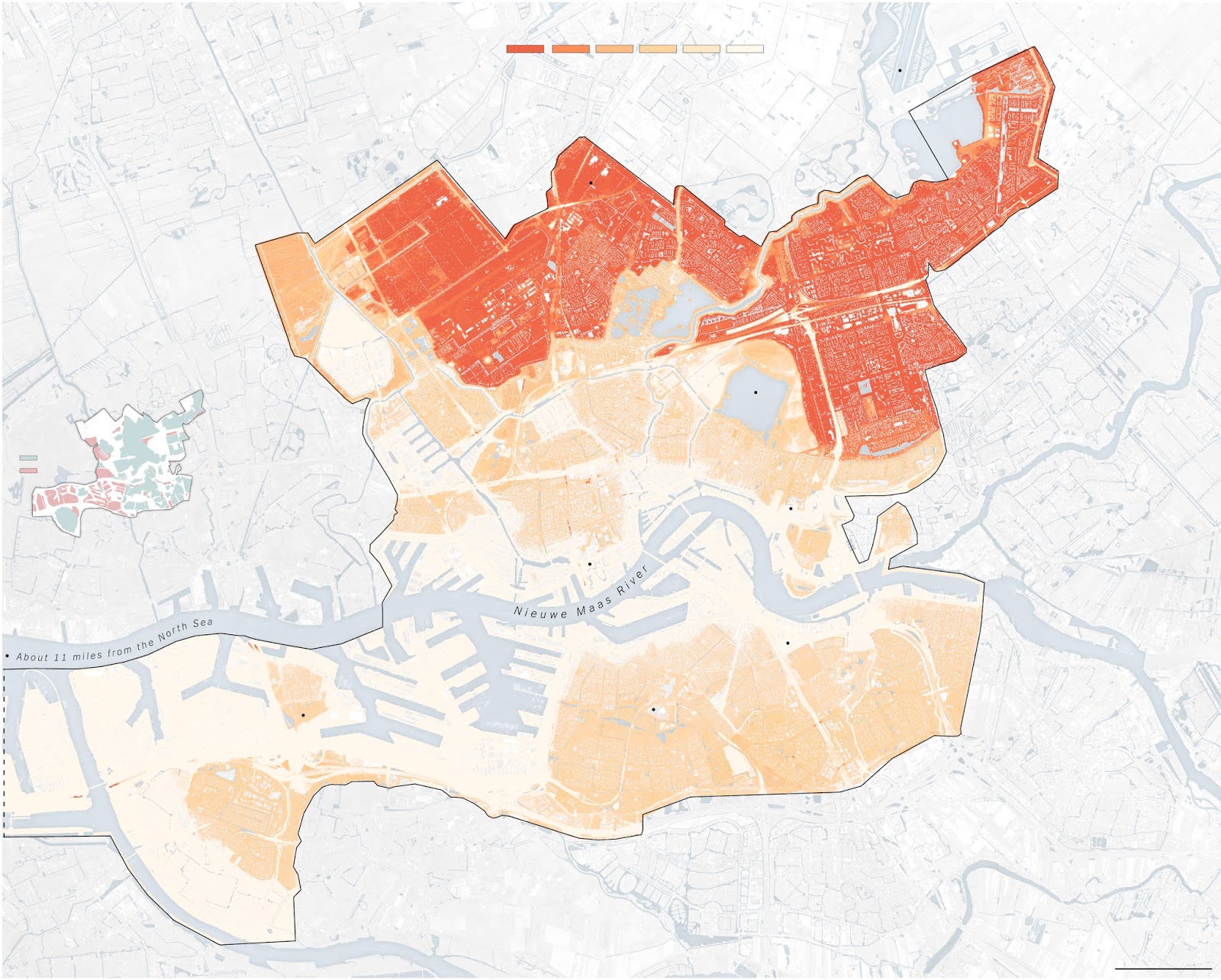
I read an interesting article about Rotterdam and the Netherlands in the New York Times of which I will copy the first paragraphs below. I read it because of a a conversation I had with the director corporate strategy of the Port of Rotterdam. In preparing the interview I read a couple of articles and power point presentations about Rotterdam and the Paris Climate Agreement. Very interesting stuff!
ROTTERDAM, the Netherlands — The wind over the
canal stirred up whitecaps and rattled cafe umbrellas. Rowers strained
toward a finish line and spectators hugged the shore. Henk Ovink,
hawkish, wiry, head shaved, watched from a V.I.P. deck, one eye on the
boats, the other, as usual, on his phone.
Mr. Ovink is the country’s globe-trotting
salesman in chief for Dutch expertise on rising water and climate
change. Like cheese in France or cars in Germany, climate change is a
business in the Netherlands. Month in, month out, delegations from as
far away as Jakarta, Ho Chi Minh City, New York and New Orleans make the
rounds in the port city of Rotterdam. They often end up hiring Dutch
firms, which dominate the global market in high-tech engineering and
water management.
That’s because from the first moment settlers
in this small nation started pumping water to clear land for farms and
houses, water has been the central, existential fact of life in the
Netherlands, a daily matter of survival and national identity. No place
in Europe is under greater threat than this waterlogged country on the
edge of the Continent. Much of the nation sits below sea level and is
gradually sinking. Now climate change brings the prospect of rising
tides and fiercer storms.
From a Dutch mind-set, climate change is not a hypothetical or a drag on
the economy, but an opportunity. While the Trump administration
withdraws from the Paris accord, the Dutch are pioneering a singular way
forward.
It is, in essence, to let water in, where possible,
not hope to subdue Mother Nature: to live with the water, rather than
struggle to defeat it. The Dutch devise lakes, garages, parks and plazas
that are a boon to daily life but also double as enormous reservoirs
for when the seas and rivers spill over. You may wish to pretend that
rising seas are a hoax perpetrated by scientists and a gullible news
media. Or you can build barriers galore. But in the end, neither will
provide adequate defense, the Dutch say.
And what holds true for managing climate change
applies to the social fabric, too. Environmental and social resilience
should go hand in hand, officials here believe, improving neighborhoods,
spreading equity and taming water during catastrophes. Climate
adaptation, if addressed head-on and properly, ought to yield a
stronger, richer state.
This is the message the Dutch have been taking
out into the world. Dutch consultants advising the Bangladeshi
authorities about emergency shelters and evacuation routes recently
helped reduce the numbers of deaths suffered in recent floods to
“hundreds instead of thousands,” according to Mr. Ovink.
“That’s what we’re trying to do,” he said. “You
can say we are marketing our expertise, but thousands of people die
every year because of rising water, and the world is failing
collectively to deal with the crisis, losing money and lives.” He ticks
off the latest findings: 2016 was the warmest year on record; global sea
levels rose to new highs.
Rowing teams practice at the Eendragtspolder, a site intended to be both a public amenity and a reservoir for floodwater.
He proudly shows off the new rowing course just
outside Rotterdam, where the World Rowing Championships were staged
last summer. The course forms part of an area called the
Eendragtspolder, a 22-acre patchwork of reclaimed fields and canals — a
prime example of a site built as a public amenity that collects
floodwater in emergencies. It is near the lowest point in the
Netherlands, about 20 feet below sea level. With its bike paths and
water sports, the Eendragtspolder has become a popular retreat. Now it
also serves as a reservoir for the Rotte River Basin when the nearby
Rhine overflows, which, because of climate change, it’s expected to do
every decade.
Interested in keeping up with climate change?
Sign up to receive our in-depth journalism about climate change around the world.
The project is among dozens in a nationwide
program, years in the making, called Room for the River, which
overturned centuries-old strategies of seizing territory from rivers and
canals to build dams and dikes. The Netherlands effectively occupies
the gutter of Europe, a lowlands bounded on one end by the North Sea,
into which immense rivers like the Rhine and the Meuse flow from
Germany, Belgium and France. Dutch thinking changed after floods forced
hundreds of thousands to evacuate during the 1990s. The floods “were a
wake-up call to give back to the rivers some of the room we had taken,”
as Harold van Waveren, a senior government adviser, recently explained.
“We can’t just keep building higher levees,
because we will end up living behind 10-meter walls,” he said. “We need
to give the rivers more places to flow. Protection against climate
change is only as strong as the weakest link in the chain, and the chain
in our case includes not just the big gates and dams at the sea but a
whole philosophy of spatial planning, crisis management, children’s
education, online apps and public spaces.” TO READ FURTHER, click HERE
When those responsible for global financial policies say they want to avoid another global financial crisis, I do not believe them because a crisis suits both private capitalists and state capitalists (eg the Chinese). It gives them the opportunity to get "assets" such as ports (eg Piraeus) and other utilities at a low price, creates the legitimacy to reduce labour costs, dismiss workers and make their employment contracts more flexible and, more generally, allows them to prescribe and apply austerity policies.
Another reason why politicians were not really dissatisfied with earlier global financial crises that have occurred since the sixties of the twentieth century is that they created the opportunity to maintain the military supremacy of the United States. In each international crisis of the dollar the countries have taken the deliberate political decision to continue supporting the global financial system based on the dollar, thus financing the military costs of the US, or have been forced to support it since there was no alternative.
Do the euro and renmimbi threaten the survival of the global financial system based on the dollar? No. The European Union continues to support the dollar-based system, as it continues to support NATO, and China may say that it favours a larger role for SDR, but that is not a threat to the current system, nor is the incorporation of renmimbi in the SDR basket a threat.
Will the current global financial system based on the dollar be with us forever? Here we have the famous saying, I think (but I'm not sure), of a well-known Dutch central banker, Jelle Zijlstra: 'When we had a crisis of the pound sterling as the key currency of the IMS, we were able to move towards the adoption of the dollar. But, where can we go when there is a crisis of the US dollar? To the moon?'
However, I still believe in the possibility of transforming the current global financial system into a better system, eg by adopting an updated version of Keynes' proposal of an international clearing agency (see Jane D'Arista's upcoming book "All Fall Down: Debt, Deregulation and Financial Crises", and Jan Kregel's A Blueprint for Reform of the International Monetary System (2)).
Why do I believe that? Because at a certain moment it will be in the interest of those responsible for global financial policies to reform the system.
So far the poor have suffered from global or regional financial crises, while the rich have benefited from them. But that does not mean it will always be like that. Climate change is now seen by the rich as a threat.
When will global financial crisis be seen by global financial policymakers (businesses, central banks and ministries of finance) as a threat rather than an opportunity?
For ten years, Percy Mistry was the man with whom I worked most
closely within FONDAD. A friend of mine who worked at the World Bank
said to me at the end of the eighties: maybe he will soon leave the
World Bank and if I were you I would immediately contact him. A
large number of books that I have published as director and
editor-in-chief of FONDAD have been written by Percy (see Fondad publications by Percy Mistry).
But here I
want to talk about his 'sister' or the lady he introduced to me as
his sister when we saw each other again after 20 years, but who is
actually his cousin: her mother is his father's sister, but the two
families have lived in the same family building in Bombay and they
grew up like sister and brother. Percy lives in Bombay for the winter part of
the year, his permanent home is in Oxfordshire in the UK.
Percy and I saw each other back at CCI, or the Cricket Club of
India. Just like at the Willingdon Sports Club we sat at a table on
the lawn, a kind of outdoor terrace, and because there was a lot of
noise and I was sitting next to Percy's sister, I had a conversation
with her, while Aafke on the other side of the table had a
conversation with Percy and his protégé who worked at the OECD. Percy has a
serious illness and after half past eight in the evening is only
capable of falling asleep or watching TV.
His sister told me about her mother who gambled money at horse
racing, but she also told me about another cousin of hers who is
committed to
teaching children from slums. That cousin has already made thousands
of slum (and disabled) children happy with education that was
not only focused on learning but also on drawing and sports. And so
for me, and later also for Aafke, the first-class lady became a
lively, sweet woman with whom Aafke had a conversation about her
youth at Catholic boarding schools in India and in Switzerland.
As a kid I liked numbers and the sound of strings. I considered studying engineering but chose social sciences because of my interest in people. I combine a theoretical interest with a practical, social approach which brought me to the sphere of policy research. I am interested in reducing the disparity between poor and rich, between the powerful and the less powerful.
In 1973 and 1982 I lived in Latin America. In the mid-1980s, I was able to create an international forum to discuss the functioning of the international monetary system and the debt crisis, the Forum on Debt and Development (FONDAD). I established it with the view that the debt crisis of the 1980s was a symptom of a malfunctioning, flawed global monetary and financial system.
I was one of the driving forces behind the creation of the European Network on Debt and Development that was established at the end of the 1980s to help put pressure on European policymakers.
In 1990, before the beginning of the Gulf War, I cofounded the Golfgroep, a discussion group about international politics comprising journalists, scientists, politicians and activists that meets regularly.
The website of FONDAD is www.fondad.org