Thursday, July 2, 2015

Are Greece's creditors killing the dream of a united and democratic Europe?

Yesterday (Thursday) I've read a number of authors arguing that the lack of a deal between the current Greek government (elected only 5 months ago) and Greece's creditors will have serious consequences including the (further) erosion of the European Union and its dream of democracy. To me it seems as if the majority of Europe's current leaders are determined to defend the current political order in which there is little or no room for divergency -- which reminds me of a book that I edited and gave the title "Diversity in Development: Reconsidering the Washington Consensus".

One of the interesting chapters in this book about the need for divergency of views on economic policies, written by Ricardo Ffrench-Davis, advocated that the neoliberal Washington Consensus reforms be reformed: Reforming the Reforms of the Washington Consensus.

A similar thing should be done right now: reforming the reforms the Troika is imposing on diverging governments as if the Troika's dictated reforms are the indisputable medicine to be swallowed -- for the health of the patient.

In the interview below in Le Nouvel Observateur, Stathis Kouvelakis, member of the central committee of Syriza, sees the way the Greek crisis evolves as the end of a certain idea or illusion of Europe and the imposition of its antidemocratic character.

Pourquoi le Premier ministre grec, Alexis Tsipras, a-t-il décidé un référendum ?
- Alors qu’il avait signé de sa propre main les dernières propositions présentées aux institutions européennes, celles-ci ont voulu le soumettre à un exercice d’humiliation en lui demandant d’aller encore plus loin, au-delà de ce qui était politiquement gérable par lui : il était devenu clair que son propre parti, sa majorité parlementaire et une partie croissante de la société n’étaient pas prêts à faire davantage de concessions.
Comment en est-on arrivé là ?
– Il n’y a pas eu de négociations. Le terme est inadéquat pour décrire ce qui s’est passé. Les institutions européennes ont gardé la même ligne depuis le début : imposer à Tsipras un plan d’austérité, le forcer à rester dans un cadre identique à celui de ses prédécesseurs et montrer ainsi que les élections en Europe, a fortiori quand c’est un parti de gauche radicale anti-austérité qui gagne, ne changent rien aux politiques qui sont suivies.
Ce qu’on appelle des négociations n’a été qu’un piège mortel qui s’est refermé sur Tsipras. Son erreur, c’est de ne pas l’avoir compris à temps. Il pensait qu’en poussant les discussions le plus loin possible les Européens finiraient par se résoudre au compromis plutôt que de prendre le risque d’une rupture. Mais ils n’ont rien cédé, alors même que lui a perdu beaucoup : il a fait d’énormes concessions, l’opinion publique s’est habituée à l’idée qu’un accord était possible, les caisses publiques sont vides.
N’a-t-il pas aussi fait l’erreur de croire qu’il pouvait obtenir moins d’austérité tout en restant dans l’euro ?
– Je fais partie de la tendance, au sein de Syriza, qui pense depuis le début que vouloir concilier le rejet de l’austérité et le maintien dans la zone euro est contradictoire. Or on a vu, dès que la Banque centrale européenne a décidé en février de couper le principal moyen de financement des banques grecques, que ce n’était pas possible. L’arme monétaire a servi de moyen de pression sur la Grèce afin de la forcer à renoncer à sa politique anti-austérité.
Le dernier épisode de ce chantage, c’est lorsque l’Eurogroupe, en refusant de prolonger le programme actuel, a contraint Tsipras à fermer les banques cette semaine. Le but est politique : en prenant les Grecs en otage et en créant une situation de panique, notamment dans les classes moyennes et aisées, il s’agit soit de forcer le gouvernement à ne pas aller jusqu’au référendum, soit de dicter les conditions de son déroulement et de favoriser le camp du oui. L’Europe a déclaré la guerre à la Grèce.
La société grecque semble très divisée…
– Oui, deux tendances s’affrontent. Le camp du non s’appuie sur une partie de la population très affectée par l’austérité, qui perçoit les exigences de la troïka comme une volonté d’humilier la Grèce. Mais le camp du oui, renforcé par la peur que suscite la fermeture des banques, est aussi en train de se structurer. Nul doute que ce référendum est un acte politique courageux. Les décisions importantes sont toujours risquées. On avait fini par oublier au fil du temps que la politique s’est rapetissée en Europe.

"La fin d'une illusion sur l'Europe"

Quels sont les scénarios possibles à l’issue du référendum ?
– Une victoire du oui serait une défaite majeure pour Tsipras et le contraindrait sans doute à organiser de nouvelles élections. Mais une victoire du non renforcerait sa détermination face aux institutions européennes en lui donnant un mandat différent de celui du 25 janvier : il s’agirait désormais de rompre avec l’austérité, quelles qu’en soient les conséquences – y compris si cela signifie sortir du cadre européen. Lorsqu’il a annoncé la tenue du référendum, c’était la première fois que le mot "euro" ne figurait pas dans son discours. Ce n’est pas un hasard.
Est-ce l’acte de décès de l’Europe ?
– Tout le déroulement de la crise grecque signe la fin d’une certaine idée, ou plutôt d’une illusion entretenue au sujet de l’Europe. Son caractère antidémocratique qui ne respecte que la loi du plus fort, son néolibéralisme qui méprise tout contrôle démocratique sont perceptibles par tous désormais. Tous ont pu se rendre compte que, même si Syriza n’a cherché qu’une rupture partielle avec les politiques d’austérité, une rupture modérée, pragmatique, et sans remettre en question les fondamentaux du cadre européen, l’affrontement a été ultraviolent. Simplement parce que ce gouvernement n’était pas prêt à capituler face au diktat néolibéral.
Même si l’Europe parvient à vaincre la résistance des Grecs, elle paiera, je crois, un prix très lourd pour son attitude. Car la Grèce n’est que la pointe avancée de la crise européenne : le projet communautaire est de moins en moins soutenu par les opinions publiques.
Propos recueillis par Sarah Halifa-Legrand

Dijsselbloem on 'no' and Varoufakis on 'yes'

Another day with dramatic news about the conflict between Greece and its creditors?

I just read the Dutch press reporting on a Dutch parliamentay meeting with Dijsselbloem The headings are: "Geen plaats in de eurozone voor Griekenland bij nee", "Grieken moeilijk in euro te houden bij 'nee'-stem", "Dijsselbloem: bij nee is het de vraag of Griekenland in de euro blijft". In plain English: Dijsselbloem suggests that Greece will/should leave the eurozone if the Greeks vote 'no'.

Varoufakis said to Bloomberg that he will step down if  the Greeks vote 'yes'.
Updated on

In an interview with Bloomberg TV's Guy Johnson, Greek Finance Minister Yanis Varoufakis said he would step aside if Sunday's referendum backs terms offered by international creditors

"Greece might be a Lehman moment"

I copy from an article of today (Thursday 2 July) in CNBC MoneyControl, "Greece might be a 'Lehman moment'" :

US-based investors have so far remained relatively calm in face of Greek financial and political turmoil. But one hedge fund manager wonders if the distress could be a signal of something akin to the 2008 financial crisis. "One of the many questions that remain is whether this is a 'Lehman' moment or not," Maria Vassalou, portfolio manager of the Perella Weinberg Partners Global Macro fund, wrote in a recent note.

Vassalou added that Europe will be changed regardless of what happens in Greece. "Independently of the outcome of the referendum, the dynamics of the euro zone are bound to change going forward, leading to more uncertainty in the region," she wrote. "The increased uncertainty is likely to prevent inflation from returning to its target rate in the near future and economic growth will face headwinds."   

Vassalou also noted that global markets "will see some degree of spillover effects" depending on the severity of the short-term developments in Greece. She notes that left-wing politicians elsewhere in Europe, especially Spain and Portugal, will get a boost if European creditors bend to Greek demands. "I think the gamble they are likely to take is a tough stance on Greece in order to halt the 'austerity revolt' from the other weak links of the euro zone," Vassalou wrote.
"One of the many questions that remain is whether this is a 'Lehman' moment or not," Maria Vassalou, portfolio manager of the Perella Weinberg Partners Global Macro fund, wrote in a recent note.

Read more at: http://www.moneycontrol.com/news/world-news/greece-might-belehman-moment-hedge-fund-pro_1758881.html?utm_source=ref_article
US-based investors have so far remained relatively calm in face of Greek financial and political turmoil. But one hedge fund manager wonders if the distress could be a signal of something akin to the 2008 financial crisis. "One of the many questions that remain is whether this is a 'Lehman' moment or not," Maria Vassalou, portfolio manager of the Perella Weinberg Partners Global Macro fund, wrote in a recent note. "It might be, but I think nobody can answer this question with great certainty at this point. It will have to be seen." Read More: PM Tsipras: Greece will go ahead with referendum Vassalou added that Europe will be changed regardless of what happens in Greece. "Independently of the outcome of the referendum, the dynamics of the euro zone are bound to change going forward, leading to more uncertainty in the region," she wrote. "The increased uncertainty is likely to prevent inflation from returning to its target rate in the near future and economic growth will face headwinds." The PWP Global Macro fund is down 1.37 percent net of fees this year through May, according to performance information obtained by CNBC.com. The fund, launched in late 2013, gained 17.22 percent last year. It manages approximately USD 461 million. Vassalou also noted that global markets "will see some degree of spillover effects" depending on the severity of the short-term developments in Greece. She notes that left-wing politicians elsewhere in Europe, especially Spain and Portugal, will get a boost if European creditors bend to Greek demands. "I think the gamble they are likely to take is a tough stance on Greece in order to halt the 'austerity revolt' from the other weak links of the euro zone," Vassalou wrote.

Read more at: http://www.moneycontrol.com/news/world-news/greece-might-belehman-moment-hedge-fund-pro_1758881.html?utm_source=ref_article
"One of the many questions that remain is whether this is a 'Lehman' moment or not," Maria Vassalou, portfolio manager of the Perella Weinberg Partners Global Macro fund, wrote in a recent note.

Read more at: http://www.moneycontrol.com/news/world-news/greece-might-belehman-moment-hedge-fund-pro_1758881.html?utm_source=ref_article

Wednesday, July 1, 2015

Why are Greece's creditors so stubborn?

Given the reasonable and moderate policies of the Tsipras government (elected only five months ago) it's hard to understand why Greece's creditors are so stubborn and stick to their view of how Greece should solve its problems. Partly it's arrogance, the arrogance of power, and partly it's the defense of interests. But there's more. There's the psychology of the creditors -- of the men and women representing the creditors.

Who are they?

They are officials working at the ministries of finance, at the central banks and at the international financial institution to which they move temporarily or for a lifetime: the IMF and the ECB.

I have worked for many years with these officials, as the chair of an informal working group on international finance, and as the director of the Forum on Debt and Development FONDAD.

They are pleasant, intelligent and often soft-spoken persons. Why do they defend policies that harm the lives of people and even kill them (for example, Greek patients who die because they don't get anymore the usual medical treatment)?

Why do they think their policy prescription for Greece is the right one, even when the facts show the medicine has not worked?

The answer is simple and can be summarised in four basic observations: 
  • They are trained to think this way.
  • They are selected in these jobs because they think this way.
  • If they think differently, their bosses make them think this way.
  • They stick to what their colleagues (those who they take seriously, that is, those who think like they think; so not Varoufakis) think.
You can go deeper in trying to understand the psychology or the psyche of the officials representing Greece's creditors. But that's for another post.

Tuesday, June 30, 2015

Greece - A last minute deal? No referendum in Greece? LATEST NEWS

There seem to be last minute attenpts at reaching an agreement between Greece and its creditors...

Tuesday 30 June 2015, 15h35 : La Grèce propose un accord de financement sur deux ans
La Grèce a proposé mardi à ses créanciers de conclure avec le Mécanisme européen de stabilité (MES) un accord sur 2 ans permettant de couvrir ses besoins financiers tout en restructurant sa dette, a indiqué le bureau du Premier ministre Alexis Tsipras.
Le gouvernement explique « rester à la table des négociations » en dépit de l’organisation dimanche d’un référendum sur les discussions avec les créanciers.

Tuesday 30 June 2015 15.32 - "Greece proposes two-year debt restructure with EU"
Greece has submitted to creditors a new two-year aid proposal calling for parallel debt restructuring, the office of Prime Minister Alexis Tsipras has said, in what seemed like a last-ditch effort by Athens to resolve an impasse with lenders.
The statement came hours before Athens was set to default on a loan to the International Monetary Fund. It was unclear how creditors would respond.
"The Greek government proposed today a two-year deal with the ESM (European Stability Mechanism) to fully cover its financial needs and with parallel debt restructuring," the government said in a statement.
"Greece remains at the negotiating table," the statement said, adding that Athens would always seek a "viable solution to stay in the euro."

Wednesday 1 July 2015, 10:44. And here the news of this morning, on Wednesday, in Le Monde - L"Athènes pourrait annuler le référendum en échange de concessions sur la dette grecque" :

Le premier ministre grec, Alexis Tsipras, est-il prêt à abandonner son projet de référendum du 5 juillet sur les propositions des créanciers de la Grèce si l’Eurogroupe décidait de répondre positivement à ses nouvelles demandes d’aide financière, comme le laissaient entendre, mardi soir, certaines sources européennes ?
L’intéressé, à ce stade, n’a donné aucune indication. Mais, selon nos informations, son bras droit, le ministre des finances, Yanis Varoufakis, qui maintenait jusque-là une ligne très dure, a proposé de revenir sur la décision d’organiser un référendum contre des concessions des créanciers concernant la dette grecque. Un coup de poker qui pourrait changer la donne, alors que les ministres des finances de la zone euro doivent se retrouver mercredi à 17 h 30 pour une nouvelle réunion de l’Eurogroupe consacrée au dossier grec.


The Wednesday (12:53) latest news

Wednesday 1 July 2015, 12:53 - "Grèce: vers un accord Tsipras/UE avant le référendum?"

Tsipras prêt à sortir de l'impasse

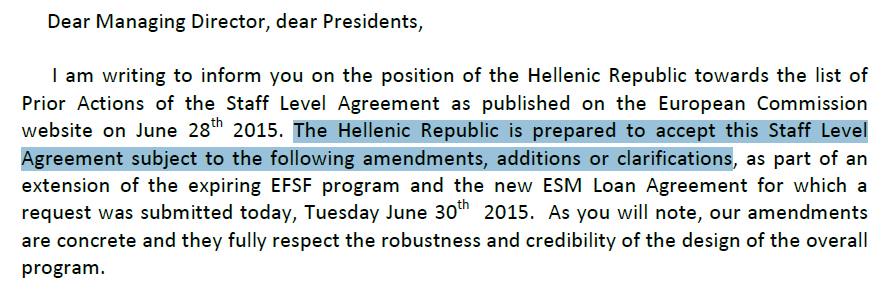
Selon le Financial Times qui a pu consulter la lettre envoyée par Tsipras mardi soir, le Premier ministre grec serait ainsi prêt à accepter les propositions des créanciers moyennant quelques menues modifications. Sur la base du document envoyé par la Commission en fin de semaine dernière, à savoir un réexamen de la dette de la Grèce en échange d'un nouveau train de mesures pour le pays, Alexis Tsipras serait enclin à trouver une sortie à cette impasse, après avoir poussé assez loin le clash avec le président de la Commission européenne, Jean-Claude Juncker.

Monday, June 29, 2015

Yanis Varoufakis' intervention at 27 June 2015 Eurogroup meeting

In my post of June 27, 2015, I copied a video in which Varoufakis explained what happened in the historic Eurogroup meeting of that day. However, I forgot to include the intervention at the meeting by Varoufakis, which he put himself on his blog, "As it happened - Yanis Varoufakis' intervention during the 27th June 2015 Eurogroup Meeting", preceded by a short introduction. Here is the first part of it: 

The Eurogroup Meeting of 27th June 2015 will not go down as a proud moment in Europe’s history. Ministers turned down the Greek government’s request that the Greek people should be granted a single week during which to deliver a Yes or No answer to the institutions’ proposals – proposals crucial for Greece’s future in the Eurozone. The very idea that a government would consult its people on a problematic proposal put to it by the institutions was treated with incomprehension and often with disdain bordering on contempt. I was even asked: “How do you expect common people to understand such complex issues?”. Indeed, democracy did not have a good day in yesterday’s Eurogroup meeting! But nor did European institutions. After our request was rejected, the Eurogroup President broke with the convention of unanimity (issuing a statement without my consent) and even took the dubious decision to convene a follow up meeting without the Greek minister, ostensibly to discuss the “next steps”. 
Can democracy and a monetary union coexist? Or must one give way? This is the pivotal question that the Eurogroup has decided to answer by placing democracy in the too-hard basket. So far, one hopes.

Intervention by Yanis Varoufakis, 27th June 2015 Eurogroup Meeting
Colleagues,
In our last meeting (25th June) the institutions tabled their final offer to the Greek authorities, in response to our proposal for a Staff Level Agreement (SLA) as tabled on 22nd June (and signed by Prime Minister Tsipras). After long, careful examination, our government decided that, unfortunately, the institutions’ proposal could not be accepted. In view of how close we have come to the 30th June deadline, the date when the current loan agreement expires, this impasse of grave concern to us all and its causes must be thoroughly examined.
We rejected the institutions’ 25th June proposals because of a variety of powerful reasons. The first reason is the combination of austerity and social injustice they would impose upon a population devastated already by… austerity and social injustice. Even our own SLA proposal (22nd June) is austerian, in a bid to placate the institutions and thus come closer to an agreement. Only our SLA attempted to shift the burden of this renewed austerian onslaught to those more able to afford it – e.g. by concentrating on increasing employer contributions to pension funds rather than on reducing the lowest of pensions. Nonetheless, even our SLA contains many parts that Greek society rejects.
So, having pushed us hard to accept substantial new austerity, in the form of absurdly large primary surpluses (3.5% of GDP over the medium term, albeit somewhat lower than the unfathomable number agreed to by previous Greek governments – i.e. 4.5%), we ended up having to make recessionary trade-offs between, on the one hand, higher taxes/charges in an economy where those who pay their dues pay through the nose and, on the other, reductions in pensions/benefits in a society already devastated by massive cuts in basic income support for the multiplying needy.
Let me say colleagues ... (for remainder, see "As it happened - Yanis Varoufakis' intervention during the 27th June 2015 Eurogroup Meeting")

The power of Greek oil and gas

I sometimes read Hellenic Shipping News, an online newspaper on Hellenic and international shipping. In today's edition there is an interesting article, "The Aegean Oil and Gas potential and the Greek national debt".

The author of the article, Jack J. Grynberg, president of Grynberg Petroleum Company, argues that Greece's oil and natural gas fields would guarantee repayment of its debt and boost the Greek economy :

"The revenues from such development, and the potential of additional oil discoveries in the Aegean Sea, would not only guarantee repayment of the massive loans that Greece owes its creditors but also give a strong sustainable boost to the Greek economy."

Greece has more "hidden" powers as you can read here:"Greece and Iran: two old friends can change the geopolitics of energy in Europe".

From this article I quote one para :

"Greece is aspiring to become a major energy player in the region, by becoming a transit country as well as a producer of natural gas for the European market. This would allow Greece to take up the role of gate keeper of the South East EU natural gas imports, coupled with potential domestic production. The country intends to achieve this in the following ways."