Wednesday, September 27, 2017

Secret EU memorandum on the privatisation of water in Greece

Painting of Thessaloniki by Aafke Steenhuis
What is prohibited by law in the Netherlands, the privatisation of water, is being forced on Greece by the European Union, as you can read in the article below.

Leaked EU Memorandum Reveals Renewed Attempt at Imposing Water Privatization on Greece

Tuesday, August 25, 2015 By Satoko Kishimoto and Olivier Hoedeman, Corporate Europe Observatory | News Analysis

The requirement to sell off €50 billion in public assets is one of the most controversial aspects of the 'agreement' that Eurozone countries and the Troika forced on the Greek government during mid-July's "night of shame".
Details of exactly what Greece is required to privatise have now emerged with the leaking of the "Memorandum of Understanding for a three-year ESM programme" prepared by the Troika's International Monetary Fund, European Commission and European Central Bank. [1] The leaked document lists 23 state assets, ranging from airports to service utilities, and presents precise steps and timelines for privatisation.
It comes as a shock that this list includes two large public water companies: Athens Water Supply & Sewerage S.A (EYDAP) and Thessaloniki Water Supply & Sewerage S.A. (EYATH), which provide drinking water for the country's two biggest cities. The Troika had insisted on water privatisation in an earlier memorandum, but strong public opposition had blocked this proposal.
In June 2014 the Council of State, the country's highest administrative court, ruled that transferring a controlling stake in Athens' public water utility EYDAP to private hands was unconstitutional because of the responsibility of the state to protect citizens' fundamental right to health. [2] The new Memorandum foresees the sale of 11% of EYDAP shares, which seems minimal at face value, but given that 38.7% of EYDAP's shares are already owned by private companies and individuals, it would leave 49.7% of the utility in private hands.
As for Thessaloniki, a non-binding referendum was held in May 2014, resulting in a 98% vote against water privatisation. This citizen-led initiative mobilised 218,002 voters and sent a crystal clear message rejecting the planned sale of 51% of EYATH shares to private investors (French water multinational Suez and Israel's state-owned Merokot had shown interest). The leaked Memorandum now orders the liquidation of 23% of state-owned shares; knowing that another 26% are already in private hands, this would make the company 49% private.
- to read further click HERE 

Friday, September 22, 2017

Dani Rodrik, Barry Eichengreen and Paul Craig Roberts

Trump's UN speech

There are articles that you may like to read or read already such as these two by authors who belong to the FONDAD Network:

"Macron’s Labour Gambit" by Dani Rodrik At the end of August, French president Emmanuel Macron unveiled the labour-market overhaul that will make or break his presidency – and may well determine the future of the eurozone. His goal is to bring down France’s stubbornly high rate of unemployment, just a shade below 10%, and energize an economy that badly needs a […]
read more...

"The Euro’s Narrow Path" by Barry Eichengreen With Emmanuel Macron’s victory in the French presidential election, and Angela Merkel’s Christian Democratic Union enjoying a comfortable lead in opinion polls ahead of Germany’s general election on September 24, a window has opened for eurozone reform. The euro has always been a Franco-German project. With a dynamic new leader in one country and a […]
read more...

And there are also articles you are not interested in because they are authored by someone you do not know, mistrust or dismiss. This may be the case with Paul Graig Roberts. Do you know who he is and what articles and books he has published? If not, you may like to read one of his latest articles, Trump’s UN Speech.

If you don't like this article or disagree with it, I wonder why and on what facts your opinion is based.

I noticed that I tended to dismiss Paul Graig Roberts' opinion after I had read on internet certain things of and about him that give reason to dismiss his opinion. But I realized this is unfair because the fact that he has written articles I do not agree with is not a good reason to dismiss other, sensible, articles by him.

Many of the things Roberts says in his article about Trump's UN speech I find sensible. There are also some things I disagree with or wonder whether he is (fully) right such as his statement or suggestion that the US "war on terror" has resulted in 'tens of millions of slaughtered, maimed, and displaced persons'. 

However, it is interesting to investigate what is true and not true in this and other statements by Paul Graig Roberts.

One, positive, reviewer (Edward Curtin) of a recent book authored by Roberts, The Neoconservative Threat to World Order, says about him: A former Assistant Secretary of the Treasury for Economic Policy in the Reagan administration and an editor and columnist for the Wall Street Journal, Paul Craig Roberts has escaped all easy labels to become a public intellectual of the highest order. He is a prolific critic of U.S. foreign and domestic policies, with a special emphasis on the nefarious influence of the neoconservatives from the Reagan through the Obama administrations. A savage critic of the mainstream corporate media – he calls them “presstitutes” – he dissects their propaganda and disinformation like a truth surgeon and penetrates to the heart of issues in a flash.

Friday, September 8, 2017

Macron wants debt relief for Greece and warns about China's presence in Europe

Piraeus: A gateway for China's New Silk Road into Europe

French president Emmanuel Macron stressed again that Greece's debt burden needs to be reduced. By the way, earlier so-called rescue packages for Greece were in fact rescue packages for French and other European banks that had made profiting loans to Greece. Below is an article from the Swiss journal Le Temps.
Does Macron also want less influence for China in Europe, given his warnng that China (Cosco) already took posession of the main part of the Port of Piraeus (see last paragraph in the article below)? Here you can see a short video I made last year about China taking control of the Port of Piraeus: The Port of Piraeus

Pour Macron, la dette grecque doit être renégociée

7 septembre 2017

Le président français a prononcé jeudi un discours sur la démocratie européenne à Athènes. Mais en arrière-plan de sa visite, un sujet principal: la dette grecque et l’Allemagne
Priorité: ne pas «braquer» Angela Merkel et son puissant ministre des Finances, Wolfgang Schaüble. Dès ses premiers entretiens à Athènes, où il a prononcé jeudi un discours sur la démocratie et l’Europe sur la colline boisée de la Pnyx, face à l’Acropole, Emmanuel Macron a confirmé à ses interlocuteurs grecs qu’il n’avait pas changé de position.
Comme conseiller à l’Elysée à partir de juin 2012, puis comme ministre, le chef de l’Etat français a toujours plaidé pour une restructuration (le fameux «haircut») de la dette publique grecque, qui se maintient depuis 2011 à plus de 170% du produit intérieur brut, aux alentours de 350 milliards d’euros. Son point de vue, selon son entourage, reste inchangé: «C’est la position de la France. Elle est connue. Il faudra mettre le sujet sur la table et l’aborder avant l’été 2018, qui marquera la fin du troisième plan d’aide européen», confirme-t-on à l’Elysée.
(...)
Sur la dette grecque, Paris estime que le moment est mûr pour bouger. «On a de plus en plus confiance sur la reprise de l’économie grecque et sur la capacité du pays à passer à quelque chose de nouveau. Nous n’avons pas de raisons de penser que le plan grec va déraper dans cette dernière ligne droite. Il est de l’intérêt collectif que les autorités helléniques puissent passer à une nouvelle phase», souligne-t-on à l’Elysée. Le troisième plan d’aide grec, approuvé en mai 2016, porte sur un montant total de prêts de 10,3 milliards d’euros, dont le versement a été achevé en juillet par le Mécanisme européen de stabilité basé à Luxembourg.

Se protéger des racheteurs extra-européens

La question qui pose problème aujourd’hui, pour aborder la réduction de la dette, est selon la France celle des «investissements stratégiques», un terme qui désigne le processus de privatisation et la revente d’actifs publics à des entreprises contrôlées par des puissances extérieures à l’UE telles que la Chine. «Il nous faut maintenant d’urgence construire des consortiums européens pour éviter que l’on ne se retrouve devant une autre cession problématique, comme celle d’une partie du port du Pirée (rachetée en janvier 2016 par le géant Cosco) aux Chinois», plaide-t-on du côté français. (...)

Wednesday, September 6, 2017

Four Lessons For Europe From Italy’s Experience With Populism

Four Lessons For Europe From Italy’s Experience With Populism


Giuliano Bobba
Giuliano Bobba
Over the past two decades, Italy has been one of the strongest and most enduring markets for populist parties in Western Europe. While in other European countries the rise or the emergence of populism is a recent development or has occurred only occasionally, it is a persistent feature of Italian politics. In the sixteen years since 2001, Italy has had populist governments for roughly half of this period (eight and a half years) if one counts the three governments led by Silvio Berlusconi that were in power from 2001 until 2005, 2005 to 2006, and 2008 to 2011. Furthermore, in the last Italian general election in 2013, populist parties (People of Freedom/Forza Italia, Lega Nord, and the Five Star Movement) gained over 50% of the vote.
Interestingly, if one looks closely enough, they can identify some common patterns characterising the emergence of populist parties in Italy. In the early 1990s, the rise of Forza Italia (FI) and the Lega Nord (LN – Northern League) was closely tied to political and economic crises. In a similar fashion, since 2008 a new period of economic and political crisis has coincided with the ascent of Beppe Grillo’s Five Star Movement. Italy thus offers a useful case study for assessing the consequences that are implied by a continuous and strong populist presence in national politics. If we look across these years as a whole, the Italian experience highlights four particular threats to democracy that can emerge from this populist presence.
First, there have been implications for the checks and balances that exist within the Italian political system. Populist parties have repeatedly attacked the work of judges, notably in the case of Silvio Berlusconi. They have also had a sizeable impact on the role of the media in Italian politics. This is true both of Berlusconi’s Forza Italia and the Five Star Movement, who have both posed a threat to the freedom and autonomy of media organisations.
Second, there has been a general oversimplification of political discourse in Italy. The debate about the cost of politics is a good example. Initially introduced by the Northern League and Forza Italia in the 1990s, complaints over the cost of politics have also become one of the most successful topics for Beppe Grillo to mobilise support around. Yet despite the presence of this debate for two decades in Italian politics, the political attention it has received has failed to produce significant savings (as shown, for instance, by several expensive and incomplete attempts to abolish provincial councils). There is cross-party consensus among the main political parties on the need to reduce the number of MPs. This implies a certain reduction of political representation, while the reduction in terms of the cost of politics is rather uncertain.
Third, Italy has experienced the spread of populist themes and frames even among non-populist parties. In the last few years, the success of populist campaigning among citizens has pushed even mainstream parties to react using populist rhetoric, styles and sometimes also populist content of their own. An example would be a much-shared Facebook post produced by Matteo Renzi on migration, which stated that ‘we need to free ourselves from a sense of guilt. We do not have the moral duty to welcome into Italy people who are worse off than ourselves’.
Finally, Italian populism illustrates the so called ‘cultivation theory’. To paraphrase George Gerbner and his colleagues, instead of ‘growing up with television’ we might address the issue of ‘growing up with populism’. Italy is now characterised by general discontent among citizens and strong political disaffection. The country is not an exception in this respect among Southern European countries and, obviously, the blame for this situation cannot be attributed solely to populist parties. Nevertheless, it is worth noting that, at least in part, the success of populist parties is achieved through the de-legitimisation of politics, institutions, and the ruling class, and that it produces a vicious circle fuelling citizens’ distrust and dissatisfaction.
Although populist parties can pose threats of this nature to democracy, usually their leaders are also political entrepreneurs that build off several problems not adequately addressed by mainstream parties. Their successes, indeed, rely on the ineffectiveness of governments to take seriously the problems identified by populist parties, such as political corruption, inefficient use of public money, the integration of migrants, and the demands of those who are excluded from the benefits of the globalisation process. Finding viable solutions to these issues is the obligatory path for Italian politics to follow if it is to reduce the growing gap that separates it from Italian citizens.
First published by LSE Europp blog
 
About Giuliano Bobba

Sunday, September 3, 2017

How Fares Emmanuel Macron?

Below you can read two articles about French president Emmanuel Macron:

France: Macron unveils assault on workers’ rights

Trade unions protested in Paris on August 31 as President Emmanuel Macron unveiled his new attacks on workers’ rights, the Morning Star said the next day. Macron’s proposed labour “reforms” would make it easier for bosses to hire and fire workers.
Macron wants parliament to vote on the new legislation — the third attack on workers’ rights in the past few years — without a chance to amend it.
The country’s labour code is seen by the neoliberal president as the major cause of joblessness in France. However, other large European countries such as Italy and Spain, with fewer protections for workers, have higher rates of unemployment.
The protest against the reforms was called by union federations CGT and Solidaires, Right to Housing and Attac France in the Parisian suburb of Jouy-en-Josas.
“Mr Macron represents the big bosses, and those who want to cut public services, social protection and everything achieved by workers,” one protester said.
The unions have called for mass demonstrations against the new law on September 12, but two of France’s biggest unions, the Force Ouvriere and CFDT, have said they will not take part. Jean-Luc Melenchon, leader of left-wing party France Unbowed, has called a further protest on September 23.
Published in www.greenleft.org.au

EXCLUSIF - La popularité de Macron dégringole encore en septembre

Dans notre baromètre mensuel YouGov, le couple exécutif voit son image se dégrader une nouvelle fois à la rentrée après un été compliqué.

04/09/2017 05:00 CEST | Actualisé il y a 1 heure

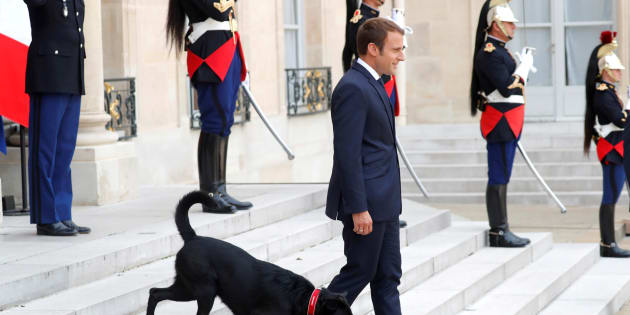
Charles Platiau / Reuters
Après un été difficile, la cote de popularité du président Macron chute encore de 6 points dans notre baromètre YouGov.
POPULARITÉ - Le mois d'août fut morose, la rentrée n'est guère plus réjouissante. La cote de popularité du couple exécutif poursuit sa chute vertigineuse. Selon notre baromètre mensuel réalisé par YouGov pour Le HuffPost et CNews, Emmanuel Macron voit son image se dégrader pour le deuxième mois consécutif dans l'opinion. Sa cote de confiance perd 6 points en septembre pour atteindre 30% d'opinions favorables après en avoir perdu 7 au mois d'août.
Un désamour qui justifie amplement le changement de stratégie de communication de l'Elysée. Mais celui-ci n'a pour l'heure pas eu le temps d'infuser dans l'opinion. Il faudra attendre le mois d'octobre pour déterminer si l'hémorragie a été enrayée.
En plein débat sur la réforme du code du travail, c'est du côté des électeurs socialistes (-8 points) et d'extrême gauche (-7 points) que la baisse est la plus notable. Mais le coeur de cible électoral du président n'échappe pas à la décrue: le chef de l'Etat perd encore 6 points chez les électeurs du centre. A l'inverse, Emmanuel Macron regagne 6 points chez les sympathisants Les Républicains (à 45% d'opinions favorables), preuve que les réformes libérales et les coupes budgétaires ordonnées par l'exécutif ne déplaisent pas à tout le monde. ... (to read further, click the title of the article)

Sunday, July 23, 2017

"The EU is a neoliberal project..."

You may find this article in the New Statesman interesting:

Lexit: the EU is a neoliberal project, so let's do something different when we leave it

Brexit affords the British left a historic opportunity for a decisive break with EU market liberalism.

Thursday, July 6, 2017

"Our democracy is under siege by the plutocratic elite"

Here is a speech that might inspire policymakers in countries that aim at putting markets under strict democratic control to avoid monopolies, booms and busts and extreme concentration of wealth. The speech was published by Social Europe. The author quotes a Swedish social democrat who once said: “The market is a useful servant, but an intolerable master”. He stresses that "underlying the demise of neoliberalism is a financial system out of control."


What Can We Learn From The Nordic Model?


Jón Baldvin Hannibalsson
The neoliberal era started in the eighties as a revolt against the welfare state. It was a reassertion of the fundamentalist belief in market infallibility. It turned out to be a repeat version of history: Essentially it leads to casino capitalism, in the thrall of high finance, just as in the stock exchange crash in 1929. Austerity-like policies to deal with the consequences deepened the crisis, then as now, and ended in a decade-long Great Depression.
The bankruptcy of Lehman Brothers in 2008 signified the end of that neoliberal era. Once more, this version of unregulated capitalism crashed. It ended in the biggest rescue operation by the state in history. Stimulus packages by the state and quantitative easing (printing money) by central banks on a massive scale rescued us from a new Great Depression.
Instead, we are now experiencing the Great Recession. What is the difference? A massive bail-out of the financial system by tax-payers. Once again, unregulated capitalism had to be saved from the capitalists – by the state. This has revealed neoliberalism to be what it is: pseudo-science in the service of the super-rich. Just like Soviet communism it is a fundamentalist dogma, which has utterly failed the test of implementation. And in so far as it is in the service of privileged elites and rejects the role of the democratic state in taking care of the public interest it is in essence anti-democratic.

Dying neoliberalism

Underlying the demise of neoliberalism is a financial system out of control. In the years 1980-2014 the financial system grew six times faster than the real economy. The fundamentalist belief driving it is that the sole duty of corporate CEOs is to maximize short-term profits, share prices and dividends. Those perverse incentives are used to justify executive salaries more than 300 times higher than those of average workers; and obscene bonuses.
This is many times more than in any other sectors, although managing money creates no comparable value. As such, this financial system has turned out to be the main conduit for moving streams of income and wealth from the productive sectors of society to the financial elite: from the 99% to the 1%. The share of labor in global GDP has fallen by hundreds of billions annually, while the share of income/wealth enriching the 1% has increased dramatically.
Small and medium-sized companies (SMEs) account for 67% of job creation in our societies, but receive only a fraction of total bank lending. In their single-minded pursuit of short-term profit the banks concentrate their lending on stock exchange speculation and real estate, increasing the nominal value of existing assets – creating bubbles and busts – and further enriching the rich.
This is why inequality has reached exorbitant levels in our societies. The rich are getting richer and the poor are getting poorer by the day. This is why long-term unemployment is built into the system. This is why poverty is increasing amidst plenty. This is why social cohesion is dwindling and polarisation growing. Since our leaders seem to be offering no convincing solutions, feelings of disappointment, resentment, anger and distrust are rising. Our democracy is under siege by the plutocratic elite.

Footloose finances and solidarity

This unsustainable financial system is footloose and fickle and prone to panic at the slightest sign of trouble, leaving behind scorched earth: collapsed currencies, bankrupted banks, sovereign defaults and mountains of debt to be paid by others. There is a complete disconnect between freedom and responsibility. After the crash of 2008 the system has been rebuilt on the same model. That means that we are stuck in a prolonged recession, even awaiting a new crisis. The people out there, who are suffering the consequences, are waiting for trustworthy solutions – radical reform.
What is our social democratic response to this existentialist crisis of unregulated capitalism? The basic elements of the Nordic model took shape as a response to the great socio-economic upheavals of the interwar period of the last century. In the West we observed the market failure of unregulated capitalism and the Great Depression. In the East we observed the Soviet experiment with communism: a centralized command economy run by a police state, which enforced the abolition of human rights, democracy and the rule of law.
We rejected both. We decided that we would follow the third way. We recognized the usefulness of a competitive market system, where applicable, to allocate resources and create wealth. But we put markets under strict democratic control to avoid market distortions (monopolies, booms and busts and extreme concentration of wealth). We insisted on public provision of education, healthcare and general utilities (energy, water, public transport, etc).
The means are familiar. Social insurance (sickness, accident, old age, and unemployment insurance), free access to quality healthcare and education, paid for by progressive taxation; active labour market policy to get rid of unemployment; and provide affordable housing for all. We emphasize equality of the sexes and strong support for families with children. These are redistributive policies aimed at increasing equality and social mobility – as a matter of human rights not as charity.
The result is a society where equality of income and wealth is greater than elsewhere. This means that individual freedom is not a privilege of the few, but a matter of emancipation for the many. Social mobility – the ability to advance in society, if you work hard and play by the rules – is de facto greater in the Nordic countries than elsewhere. The Nordic model has by now replaced the United States of America as the land of opportunity.
This is the only socio-economic model, emerging in the last century, that has withstood the test of time in the era of globalization in the 21st century.

Why the Nordic model works

The neoliberal creed is that the welfare state, with its high progressive taxes and strong public sector, is uncompetitive. State intervention hampers growth and innovation and results in stagnation. The bottom line: owing to its lack of dynamism, the welfare state is said to be unsustainable in the long run. And the proliferation of state bureaucracy is even said to threaten individual freedom and ultimately end in a totalitarian state (Hayek).
Now we know better. The facts speak for themselves. No matter what criteria we apply, the Nordic model is invariably at the top of the league.
This applies no less to economic performance than other criteria: Economic growth, research and developement, technological innovation, productivity per hour of work, job creation, participation in the labour market, (especially women), equality of the sexes, level of education, social mobility, absence of poverty, health and longevity, quality of infrastructure, access to unspoilt nature, the overall quality of life. Less inequality than in most places. And a vibrant democracy. What more do you want? 
What tasks lie ahead? An all-out effort against the financial elite to restrain the forces of inequality and to reclaim the power of democracy. An unyielding solidarity with Europe’s youth, who have been left to fend for themselves in the queues of the unemployed, bereft of hope. And take up the fight for the preservation of the environment and our common future on this planet.
There are three major challenges that lie ahead in the immediate and near future:
  1. Sanitise the corrupt financial system and put it back firmly under democratic control
  2. Massive investment in clean and renewable energy to replace fossil fuels as the life-blood of our economies. This is an urgent task which calls for social democrats and environmentalists to work together to save our planet
  3. Start planning now how to tackle the consequences of the technological revolution which is ongoing all around us (IT, digitization and automation)
The prospect of massive and systemic unemployment through automation calls for radical thinking about the distribution of income and the responsibilities of the democratic state in such a society. On the agenda should be proposals for a minimum basic income for all. This is a gigantic task that calls for well-designed redistributive policies in the spirit of social democracy, utterly beyond the capacity of unregulated capitalism to solve.
These three major problems, as well as relevant solutions, are inter-related.. A precondition for success in meeting them is a political alliance between social democrats, trade unions, environmentalists and the radical left among Europe´s neglected youth. The road signs are already there.
Remember the motto of Tage Erlander, the long-time leader of Sweden’s social democrats, and arguably the greatest reformer of the last century. He said: “The market is a useful servant, but an intolerable master”. And the spiritual leader of the Catholic faith, Pope Francis, agreed, when he said:
The worship of the golden calf of old has found a new and heartless image in the cult of money and the dictatorship of financial markets, which are faceless and lacking any humane goal. Money has to serve, not rule.
This is an edited version of a speech given at the celebratory 120th anniversary of the Lithuanian Social-Demcorati Party in Vilnius.