I made a short film about my friend Alan Roberts (he died a few days ago), in which he says things about South Africa that apply to similar situations in other countries.
Friday, February 2, 2024

Wednesday, November 29, 2023
THE BIG ROUGH SEA - WORLD PORTS AND GLOBALIZATION (De grote wilde vaart - Wereldhavens en globalisering)
 THE BIG ROUGH SEA - WORLD PORTS AND GLOBALIZATION / PORTS MONDIAUX ET MONDIALISATION
De grote wilde vaart - Wereldhavens en globalisering
Text on the back of the book (published by WBOOKS) / Texte au dos du livre :
Shipping, ports and trade are essential to humanity. Oceans, seas and rivers cover more than two-thirds of the Earth's surface. Since ancient times, people transported their goods across the water in rafts, canoes and sailboats. Now they sail across the oceans with container ships, bulk carriers and tankers. 90 percent of world trade moves from port to port by ship. Ports are the hubs of world society.
But ports and world trade are easily disrupted: a shipping accident in the Suez Canal, the corona pandemic, wars, climate change, geopolitical tensions. What happens in world ports? How did they originate? How have they developed? How did China's ports expand so dramatically? Can ports continue to grow indefinitely, or not? What are they doing about climate change and energy transition? What will the maritime world look like in the future?
These are questions that Aafke Steenhuis and Jan Joost Teunissen asked themselves. Over the past ten years they have traveled to crucial and colorful ports in the world, such as Shanghai, Singapore, Mumbai, Dubai, Alexandria, Cape Town, Rotterdam, Hamburg, Marseille, Genoa, Los Angeles, Santos. During that trip around the world they spoke with port experts, economists, writers and sociologists. The result is a book that is as loving as it is critical.
To order the book (in Dutch), click HERE - https://wbooks.com/.../de-grote-wilde-vaart-wereldhavens.../
Wednesday, November 2, 2022
Alexandria - Port and City (film by Jan Joost Teunissen)
Alexandria is the largest port in Egypt, handling around 60 percent of Egypt's foreign trade. It was founded by Alexander the Great who built a city that would become the most beautiful, richest and most intellectual city in the Eastern Mediterranean. It had a famous lighthouse, a huge library and a museum.
Today, Egypt is expanding the Port of Alexandria and other ports to become a hub for global trade and logistics.
The film includes a lengthy tour of the port. Alexandria is also the city where the famous poet Cafavis was born and where he died. The film includes a visit to the Cavafis House.
Jan Joost Teunissen (author of this film) and Aafke Steenhuis are writing a book about world ports and globalisation.
Jan Joost is the director of FONDAD.
Friday, March 25, 2022
“Why should we have listened better to Robert Triffin?”

There are various reasons why we should have listened better to Robert Triffin’s suggestions of how to fundamentally reform and improve the functioning of the international monetary system. He made those suggestions for the first time in 1957, in his Europe and the Money Muddle, and continued making them until a year before his death in 1993, when he withdrew from all public economic activities. I will discuss two major reasons, the first concerned with the world economic and political system, and the second with the role of economists.
A more stable system plagued less by crises
The first and main reason why we should have listened better to Robert Triffin’s suggestions for reform and improvement of the international monetary system is that the world would have been more stable and would have been plagued less by crises. Those crises have proven to be very harmful for businesses and citizens.
In 1985, three years after the world debt crisis broke out in Latin America, and led to what Latin Americans have called ‘the lost decade’, Triffin once again advocated fundamental reform of the international monetary system, just like he had done energetically during the sixties and seventies. He did so in a report that he prepared for a US Congressional Summit on Exchange Rates and the Dollar. He said, and I quote, “We should resume negotiations for a fundamental reform of the world monetary system - or non-system - that is anchored primarily on a national, paper reserve currency, that is, the dollar.”
In the view of Triffin, a key element of such fundamental reform would be to anchor the system on a truly international reserve asset held with the IMF, and not on the dollar or any other national currency used as a reserve currency. Triffin mentioned three major arguments why fundamental reform of the system was needed.
First, and I quote his 1985 paper prepared for the US Congressional Summit, “because of its fantastic inflationary proclivities, leading to world reserve increases eight times as large over a brief span of fifteen years as over all previous years and centuries since Adam and Eve.”
Second, “because of its skewed investment pattern of world reserves, making the poorer and less capitalized countries of the Third World the main reserve lenders, and the richer and more capitalized industrial countries the main reserve borrowers of the system.” In another paper Triffin said the same in stronger words. I quote from his September 1988 acceptance speech of the Seidman Award, “the richest, most developed, and most heavily capitalized country in the world should not import, but export, capital, in order to increase productive investment in poorer, less developed, and less capitalized countries. I have long argued that our international monetary system is at the root of this absurdity.”
And third, “because of its crisis-prone propensities reflected in the amplitude of the present world debt problem.”
I would say that over the past three decades we have been plagued by too many crises, first in Latin America in the 1980s, then in Mexico, Russia, Brazil and East Asia in the 1990s, and, finally, during the last two years, in the centre of the world capitalist system, the US and Europe. Now we, in Europe and in North America, also feel the pain, earlier only they, the people in the emerging economies and the developing countries, felt the pain. The crisis of the1980s was called a debt crisis, and the current crisis is called a credit crisis, but the impact of both the debt and the credit crisis on citizens and businesses is the same: bankruptcies, unemployment, impoverishment and fear. And the root cause of this and the earlier crises are also the same: a malfunctioning, insufficiently controlled and supervised, world monetary system.
Let me say a bit more about the basic flaws of the global financial system, the way I see it, but inspired by Triffin. I think the basic flaw of the system is that it is a privatised system. It is a system that lacks the necessary control and steering by national and international authorities. It is a system that gives free play to commercial banks and other private financial agencies.
Until recently, most policymakers and economists believed, or said, that banks and financial agencies provided in the most efficient way the finance needed by the world. The reality has proved to be different.
This flaw of a privatised international financial system, in which national central banks but also the European Central Bank, the Bank for International Settlements and the IMF only play a marginal role, a role in the side-scene of global finance, in the coulisse, is directly linked to that other basic flaw, stressed time and again by Triffin: a system that is based on the dollar as key reserve currency instead of a truly international reserve asset.
During the sixties and the early seventies policymakers still believed (or were they already half-hearted believers?) in international regulation of international capital flows and an important role for the IMF. But that belief faded once the US abandoned the gold value of the dollar and once commercial banks began to recycle petrodollars, Eurodollars (that is, dollars held outside the United States), and other major currencies. As Triffin recalls in many of his papers and speeches, policymakers not only believed in international regulation but also negotiated a fundamental reform of the system in the so-called Committee of Twenty. When the Committee agreed in 1974 on a reform plan, the basic ideas of Triffin’s reform plan were included. However, the plan was never put into practice. Why not? Because the private banks were already providing the international liquidity, in the form of dollars, needed by businesses and countries, and because the NATO countries did not really want to get rid of the dollar as key currency (I will come back to this role of the NATO countries, as seen by Triffin). So the reform plan was shelved and the US dollar remained king of the system.
This was very unfortunate and disappointing for Triffin and others who had advocated for years a more stable and equitable, just, world financial system. They wanted a system that would put an end to increasing global imbalances, put an end to recurring financial crises, and put an end to the “exorbitant” privilege of the United States to finance its military expenditures and wars with money provided by the rest of the world.
This is the system, or non-system as Triffin called it, that we still have today and that should have been reformed a long time ago, to prevent the crises that have made and still make suffer so many people. Just to give you one figure, the International Labour Organisation has calculated recently that in the course of this year, in Asia alone, 23 million people are expected to lose their jobs because of the crisis.
The role of economists
This brings me to the second major reason - or set of reasons because the first reason I gave was in fact more than just one - why we should have listened better to Robert Triffin. This second set of reasons has to do with Triffin’s view on the role of economists, with the ethics of economics, with the human drive, the man-made rules and the political power behind economics. All in economics is the result of what people do, individually, and collectively.
There are no natural laws in economics as in the natural sciences, only human laws. If we want to change things in the economy, we have to change human actions, human thoughts, human behaviour. Economics is the result of human actions. As Triffin said to me when I interviewed him in the mid-1980s, “Just as Clemenceau once said that war is much too serious a thing to be left to the generals, I think the economy is far too serious a thing to be left to the economists.”
Triffin was moved by concern with people and was moved by concern with countries, not one country but all countries of the world. He considered himself a world citizen. Triffin was a “committed” economist, an economist committed to a “cause”. He was the kind of economist of whom we had too few and still have too few.
Triffin did not confine himself to ivory tower analysis or to conformist analysis. He rejected the conformism of many of his colleagues when they whitewashed policies instead of criticising them and showing the shortcomings and bad consequences of them.
Economists tend to look at only a small part, I would say a minor aspect, of human behaviour. Triffin did not think that economists should limit themselves to that minor aspect (“minor” is my wording) of human behaviour. He thought that economists should learn from other social sciences, from history, from philosophy, and be inspired by human concerns. As you may know, he originally would have liked to study literature and philosophy, but he realised those studies were for the elite, not for the son of a small farmer.
Triffin was not only an economist moved by human concerns, he was also a brilliant, visionary economist who was driven by intellectual curiosity and had written a prize-winning theoretical dissertation with Professor Schumpeter called Monopolistic Competition and General Equilibrium Theory (1940). After that, he continued making in-depth analyses of the dynamics in the world economy.
Triffin was very successful in predicting important economic events. Indeed, he predicted the fall of the Bretton Woods system long before it really happened. He did so already in 1957, in his book Europe and the Money Muddle. It would take another 14 years before his prediction became true, in August 1971, when the US announced that it would no longer exchange gold for dollars. The dollar became a paper currency and flooded the world.
But Triffin did not enjoy that his predictions became true; he regretted it. He would rather have preferred that his efforts, and that of others, had resulted in a fundamental reform of the Bretton Woods system before it collapsed. Triffin was one of the most energetic participants to the so-called Bellagio Group meetings of academics and policymakers. They met regularly throughout the sixties in a castle in Bellagio to discuss the problems of the international monetary system, and develop ideas of how to improve and reform it.
When I met Triffin for the first time, in January 1985, here in Louvain-la-Neuve, I was impressed by his efforts to influence the policymakers’ minds in those Bellagio Group meetings and other meetings he had with them. I thought I should do something similar and I discussed with him my plan to set up a forum to discuss the malfunctioning of the international monetary system and to develop ideas of how to improve it, particularly with a view to the fate of developing countries. Triffin warmly supported my plan and made various suggestions with regard to the topics that we might discuss and the people whom I might want to involve.
To make a long story short, I succeeded in establishing the FONDAD forum in 1987 and over the past twenty years I was able to hold numerous international meetings in the spirit of the Bellagio Group. Prominent experts from academia, central banks, ministries of finance, the IMF, the BIS, UN agencies, the World Bank, commercial banks and ministries of foreign affairs, attended the meetings. At almost every meeting we discussed how the global financial system could be improved and how financial crises could be prevented. Unfortunately, little of all the good ideas was put into practice. Even though some members of the FONDAD group foresaw many years ago a credit (or debt) crisis in the United States - Bill White, the chief economist of the BIS was one of them - that crisis was not prevented.
Why did they not listen to Triffin (and FONDAD)?
The lack of success in improving and reforming the international monetary system is something Triffin had to live with. He felt his advice was right and his Plan for Reform of the international monetary system was right, but policymakers preferred to go on as usual: letting emerge financial crises and then trying to manage them. That is what we have seen time and again over the past thirty or forty years, and that is what we are seeing now, in the midst of a serious crisis that evokes memories of the depression of the 1930s - it’s crisis management again.
This sounds depressing, I say with a smile. First, we had Triffin who saw that his Reform Plan was shelved, and then we had the FONDAD group that did not get sufficient support for its ideas to improve the system and prevent crises.
Why did I say this with a smile? Because you would be depressed only if you had expected a different course of events. Sure, I had hoped that we would have been more successful in improving the system and preventing the crises, and so did Triffin. But I anticipated that it would be difficult, and so did Triffin.
When Triffin grew older, he became a little bit disappointed that his colleagues in academia and policymaking circles did do so little, or nothing, to fundamentally improve the system and prevent crises. When I asked him in the mid-1980s if he knew and could explain why his Reform Plan, adopted by the Committee of
Twenty in 1974, was shelved and why policymakers and academics did not push for reform in the years thereafter, his answer was as follows:
First, the maintenance of the dollar as the key currency of the system meant that the United States could continue to spend as much as it wished on the military. Though Triffin opposed the huge military expenditures by the US (and by other countries), he knew that the NATO allies supported it, both politically and financially, by continuing their use of the dollar as the main reserve currency and by continuing to invest in the United States. My own country, the Netherlands, is a good example. Politically and militarily, it has always supported the US in its military interventions and wars, even if these interventions and wars did not respect international law. And the Netherlands has also been a huge investor in the US. During a couple of years it was even the largest foreign investor in the United States. As Triffin said, and I quote him, “Although this is never openly said, the Americans, and most Europeans, too, saw the maintenance of the dollar as the reserve currency as a way of financing their joint defence. And this is still true today, I think.”
Second, Triffin explained that routine and fear for change played a large role. Policymakers tend to stick to what they are used to, even if it brings crisis, because they are used to handling crisis, they feel they are masters in crisis management. I would add that so far they have been rather successful in crisis management, but, I would add immediately too, not always to the agreement and happiness of the citizens and governments of the countries affected. During the last big crisis before the current one, the Asia crisis of 1997-98, many Asians were so unhappy with the recipes of the IMF, the United States and other NATO countries that they took steps towards Asian monetary cooperation and built huge international reserves to be better prepared for the next crisis. Are routine and fear for change still blocking a push for reform? Yes, I think so.
Third, Triffin explained that the US just wanted to maintain its “exorbitant privilege” to be able to borrow as much as it wanted from other countries, including the developing countries, so that the US could easily settle its trade deficit and its budgetary deficit. Unfortunately, this was already a reality in the 1980s and it still is the reality today. In his 1985 report for the US Congressional Summit on Exchange Rates and the Dollar Triffin wrote, “...the United States is no longer playing its traditional role as a ‘world banker’. Only a decreasing fraction of large and continuing inflows of foreign capital to the exchange market is now recycled abroad: 13 percent in 1984 as against 110 percent at the peak in 1981. This is in part the result of the world debt crisis that had to sanction, sooner or later, the international lending spree. It is also the result, however, of the way in which the domestic recovery of the United States was promoted by a domestic borrowing spree, and particularly by budgetary deficits hovering around $200 billion per year, and of which about half was financed last year by capital flows
from the rest of the world.”
These figures given by Triffin in 1985 were staggering. But do you know the expected US budget deficit of this year? $1.8 trillion, or 13.1 percent of US GDP. Again, a lot of foreign capital will flow to the United States.
In the report that Triffin prepared in 1985 for the US Congressional Summit on Exchange Rates and the Dollar he raised the question of how the flow of foreign capital to the United States could be reduced. More than half of the growth of foreign capital inflows, Triffin said, was the result of central banks buying US Treasury bills and commercial banks increasing their claims on US banks. Why did central and commercial banks lend so much to the US?
“This is primarily due to the role of the dollar as the main ‘parallel’ world currency (as the key currency of the system),” said Triffin, “used in international contracts and settlements and accumulated in official reserves and private working balances.” Today this still is the case.
Obviously, the best way to end this unhealthy lending to the US, argued Triffin, would be to reform the international monetary system and, as he said in his report to the US Congressional Summit, “switch from the dollar to reserve deposits in the IMF as the main component of international reserves, and even for stabilization interventions in the exchange market. This would require, of course, that reserve deposits with the Fund be made accessible at least to commercial banks, if not to other private holders.”
Triffin then added, “You will not be surprised to hear that I would strongly advocate the resumption of negotiations aiming at such a fundamental reform of the international monetary system.” And, once again, he explained what the main obstacle to such reform was. “The main obstacle to a worldwide agreement continues to be the reluctance of the United States to abandon its traditional privilege to finance both its international deficits and a growing fraction of its budgetary deficits with its own IOUs (that is, dollars).”
However, Triffin predicted, and I quote him, “In the absence of US agreement, other countries are likely, sooner or later, to take the initiative in this respect [he meant, switching from the dollar to a truly international reserve currency], in order to reduce their overdependence on the vagaries of the fluctuating, inconvertible, paper dollar.”
24 years later, in 2009, those “other countries” have emerged. Ten days before the meeting of the Group of Twenty on April 2nd, China said that the time was ripe for fundamental reform of the international monetary system and so did Russia, and they got support from countries such as Malaysia, Brazil and Indonesia.
It was the head of the Chinese central bank, Mr. Zhou, who called in a paper for the creation of a new international reserve currency to replace the dollar. In his paper, Mr. Zhou referred to Triffin and said, “The desirable goal of reforming the international monetary system is to create an international reserve currency that is disconnected from individual nations and is able to remain stable in the long run, thus removing the inherent deficiencies caused by using credit-based national currencies.”
Three years earlier, Fan Gang (a member of the Monetary Policy Committee of the Chinese central bank) had made a similar plea in his contribution to a FONDAD conference and book on global imbalances. He said, “The US dollar is no longer a stable anchor in the global financial system, nor is it likely to become one: thus, it is time to look for alternatives.”
As China is one of the major economies and one of the largest holders of dollar reserves, the news spread quickly. “China Urges New Money Reserve to Replace Dollar,” was the heading of The New York Times (23 March). “China calls for the reign of the dollar to end,” said the British Telegraph. “Russia recently made a similar proposal,” added The New York Times.
“Indonesia, Malaysia, Thailand Support Call for Global Currency,” said the US news agency Bloomberg. “Stiglitz’s U.N. Panel Urges to Replace the Dollar - The commission led by Nobel economist Joseph Stiglitz recommends a new global currency,” said Business Week.
“A reserve currency system based on an IMF unit instead of the U.S. dollar could be phased in within a year, Nobel Prize-winning economist Joseph Stiglitz said,” was the news brought by Reuters. And so it went on for a couple of weeks. Triffin’s name and Triffin’s idea of fundamental reform was suddenly back in the news.
Will an up-to-date Triffin Plan be adopted and implemented anytime soon?
Are there chances that the policymakers of the NATO countries and of other countries will finally listen to the advice of Robert Triffin? Will the world finally adopt and implement a fundamental reform of the international monetary system in an updated version of the Triffin Plan or any other plan that departs from the same basic idea that we need a truly international global reserve asset as key currency of the system?
The reactions to the Chinese and Russian proposals seem to indicate that the process of reform will be slow. US policymakers, Japanese policymakers and a few European policy-makers immediately reacted to the news about the need for “a new global currency” by saying that a fundamental reform that implied replacing the dollar was neither necessary, nor likely in the near future. A number of academics and columnists said the same. But the UN Commission headed by Stiglitz advocated fundamental reform of the international monetary system, and so did the Italian minister of economy, Giulio Tremonti, recently, according to news agency Reuters (30 April).
So, is reform about to take place?
I don’t think so. The power groups and interest groups opposing fundamental reform of the international monetary system are still strong. The routine of the bureaucrats and bosses in both official and private institutions is likely to prevent action. The policymakers of the NATO countries - with the exception of Italy ? - do not seem to be eager starting a process of negotiating a new monetary system that replaces the dollar as key currency of the system. The Europeans rather prefer to maintain the dollar and improve financial regulation.
Does the old dream of Robert Triffin remain a dream, a utopia?
My hope is that Triffin’s dream will become true. The problems of the current system (its instability, its proneness to crisis, its unfair treatment of developing countries) are too big to let them drag on. We should not wait with reform until the next crisis emerges because the costs are too high. It would also be proof of low intellectual quality of our policymakers, and of low intellectual quality of the academics working with them, if they would let drag on the system as it is. Why should they not change it?
I’d like to end my talk with an encouraging quote from Triffin. When I interviewed him in 1985 for the Dutch and Belgian magazine Intermediair, I asked him if he was never accused of being naïve by still believing in the possibility of reforming the international monetary system.
“Yes,” he answered frankly.
- And what is your reaction to this reproach? I asked.
“Well, I give the answer Ben Gurion once gave: to be realistic today you need a great deal of utopia. Running away from the most obvious solutions is not realism. It’s crisis management, condemning you to more and more crisis management.”
Jan Joost Teunissen is the founder and director of the Forum on Debt and Development (FONDAD).
Thursday, March 17, 2022
China and Russia will speed up Reform of the International Monetary System
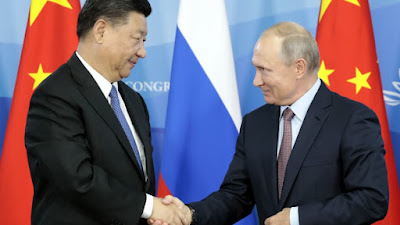
An effect not anticipated by NATO policy makers is that China and Russia will speed up Reform of the International Monetary System, argues Michael Hudson:
Michael Hudson – The American Empire self-destructs
But nobody thought that it would happen this fast.
Empires often follow the course of a Greek tragedy, bringing about precisely the fate that they sought to avoid. That certainly is the case with the American Empire as it dismantles itself in not-so-slow motion.
The basic assumption of economic and diplomatic forecasting is that every country will act in its own self-interest. Such reasoning is of no help in today’s world. Observers across the political spectrum are using phrases like “shooting themselves in their own foot” to describe U.S. diplomatic confrontation with Russia and allies alike.
For more than a generation the most prominent U.S. diplomats have warned about what they thought would represent the ultimate external threat: an alliance of Russia and China dominating Eurasia. America’s economic sanctions and military confrontation has driven them together, and is driving other countries into their emerging Eurasian orbit.
American economic and financial power was expected to avert this fate. During the half-century since the United States went off gold in 1971, the world’s central banks have operated on the Dollar Standard, holding their international monetary reserves in the form of U.S. Treasury securities, U.S. bank deposits and U.S. stocks and bonds. The resulting Treasury-bill Standard has enabled America to finance its foreign military spending and investment takeover of other countries simply by creating dollar IOUs. U.S. balance-of-payments deficits end up in the central banks of payments-surplus countries as their reserves, while Global South debtors need dollars to pay their bondholders and conduct their foreign trade.
This monetary privilege – dollar seignorage – has enabled U.S. diplomacy to impose neoliberal policies on the rest of the world, without having to use much military force of its own except to grab Near Eastern oil.
The recent escalation U.S. sanctions blocking Europe, Asia and other countries from trade and investment with Russia, Iran and China has imposed enormous opportunity costs – the cost of lost opportunities – on U.S. allies. And the recent confiscation of the gold and foreign reserves of Venezuela, Afghanistan and now Russia, along the targeted grabbing of bank accounts of wealthy foreigners (hoping to win their hearts and minds, along with recovery of their sequestered accounts), has ended the idea that dollar holdings or those in its sterling and euro NATO satellites are a safe investment haven when world economic conditions become shaky.
So I am somewhat chagrined as I watch the speed at which this
U.S.-centered financialized system has de-dollarized over the
span of just a year or two. The basic theme of my Super
Imperialism has been how, for the past fifty years, the
U.S. Treasury-bill standard has channeled foreign savings to
U.S. financial markets and banks, giving Dollar Diplomacy a
free ride. I thought that de-dollarization would be led by
China and Russia moving to take control of their economies to
avoid the kind of financial polarization that is imposing
austerity on the United States. But U.S. officials are forcing
them to overcome whatever hesitancy they had to de-dollarize.
(...)
Saturday, January 1, 2022
I cried over the death of Robert Triffin
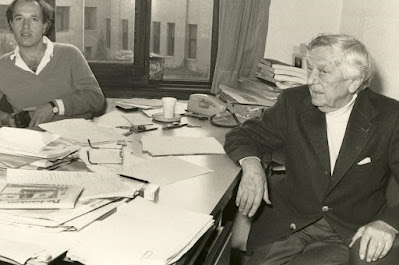
When I got home to Amsterdam, that same night I wondered why I had been crying. The answer I gave to myself was that Robert Triffin and I were united in our desire to improve the world - focusing on the role of money, of finance, in the world.
But I think there were still other, perhaps more important, reasons why I was crying...
And there is another economist in my work circle that I cried for, with real tears, on 21 September 1976: Orlando Letelier.
Thursday, December 30, 2021
Why should we have listened better to Robert Triffin?

Dear friends,
I would like to add this speech to my previous message:
“Why
should we have listened better to
Robert Triffin?”
Speech by Jan Joost Teunissen at
conference, “The economic
and financial crisis of 2008-09”, Louvain-la-Neuve, 7-8 May 2009
There are various reasons why we
should have listened better to Robert Triffin’s suggestions of how to fundamentally reform and
improve the functioning of the international monetary system. He made those suggestions
for the first time in 1957, in his Europe
and the Money Muddle, and
continued making them until a year before his death in 1993,
when he withdrew from all public economic
activities. I will discuss two major reasons, the first
concerned with the world economic and political
system, and the second with the role of economists.
A more stable system plagued less by crises
The first and main reason why we
should have listened better to Robert Triffin’s suggestions for reform and improvement of the
international monetary system is that the world would have been more stable and would
have been plagued less by crises. Those crises have proven to be very harmful for businesses
and citizens.
In 1985, three years after the
world debt crisis broke out in Latin America, and led to what Latin Americans have called ‘the
lost decade’, Triffin once again advocated fundamental reform of the international
monetary system, just like he had done energetically during the sixties and seventies. He did so
in a report that he prepared for a US Congressional Summit on Exchange Rates and the Dollar.
He said, and I quote, “We should resume negotiations for a fundamental reform
of the world monetary system - or non-system - that is anchored primarily on a national,
paper reserve currency, that is, the dollar.”
In the view of Triffin, a key
element of such fundamental reform would be to anchor the system on a truly
international reserve asset held
with the IMF, and not on the dollar or any other national currency used as a
reserve currency. Triffin mentioned three major arguments why fundamental reform of the
system was needed.
First, and I quote his 1985 paper
prepared for the US Congressional Summit, “because of its fantastic inflationary proclivities,
leading to world reserve increases eight times as large over a brief span of fifteen years as
over all previous years and centuries since Adam and Eve.”
Second, “because of its skewed
investment pattern of world reserves,
making the poorer and less capitalized countries of the
Third World the main reserve lenders, and the richer and more capitalized industrial
countries the main reserve borrowers of the system.” In another paper Triffin said the same in
stronger words. I quote from his September 1988 acceptance speech of the Seidman Award, “the
richest, most developed, and most heavily capitalized country in the world should not
import, but export, capital, in order to increase productive investment in poorer, less
developed, and less capitalized countries. I have long argued
that our international monetary system
is at the root of this absurdity.”
And third, “because of its crisis-prone
propensities reflected in the
amplitude of the present world debt problem.” ...
TO READ FURTHER, see the attached.
Subscribe to:
Posts (Atom)
